Showing posts with label seafood. Show all posts

Sunday, 6 February 2022

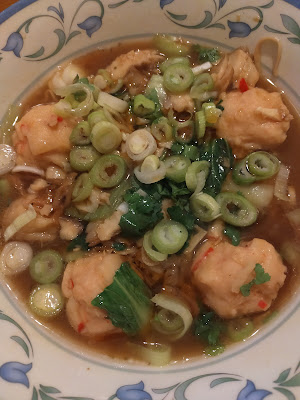
Seafood noodle soup

This was a recent suppertime experiment, inspired by finding frozen fish balls in the Vietnamese supermarket in Greenwich. These were “lobster flavour”, never claiming to actually contain lobster. They looked like they had a firm texture with good “bite” which could create interesting contrast with al dente noodles, prawns and fish. 


The soup has east Asian influences, but I cannot vouch for any kind of authenticity, nor do I claim any. As I have already said the fish balls came from a Vietnamese supermarket, and I can tell you that the dried shrimp from a Japanese grocers and the fried onion and fried garlic from a Chinese supermarket. So I used a number of east Asian ingredients, but with no unifying cultural theme for the dish. 

The result was a comforting bowl of hot soup on a cold night, dotted with seafood, full of fragrance and flavour, which managed to be light. It was warming without being heavy, leaving a feeling of comfort without feeling overindulged. We enjoyed it and intend to make it again. I hope you will like it!

Seafood noodle soup
 

Ingredients

(Serves 2 for a generous main meal)

Noodles:

2 nests dried egg noodles

1 teaspoon groundnut oil

Seafood:

6 raw king prawns, cut in half along their length

1 fillet of fish (I used tilapia on this occasion), frozen

10 fish balls (I used lobster flavour fish balls), frozen

Soup:

800ml fish stock

4 cloves garlic, peeled and sliced

1” piece of ginger, peeled in cut into matchsticks

2 tbsp dried shrimps (I used the teeny tiny Japanese dried shrimp)

2 tablespoons crispy fried onions

1 tablespoon crispy fried garlic

1 tablespoon light soy sauce

1 tablespoon fish sauce

2 tablespoons Shaoxing rice wine

1 teaspoon Asian chicken bouillon (optional, or a quarter teaspoon of MSG, also optional)

1 head of pak choi cut into 2cm chunks, split up the green and the white bits

To serve:

1 teaspoon chilli oil

1 teaspoon pure sesame oil

2 spring onions finely sliced in rounds

1 tablespoon finely chopped coriander

Method

1. Cook the egg noodles according to the pack instructions. Drain, rinse with cold water and coat with the groundnut oil to prevent sticking. Work the oil through the noodles carefully, rather than add more oil, you don’t want the soup having an oil slick over the top.

2. Heat up your stock, or if using ready made, put your stock in a pan on a medium heat. Add the dried shrimp, Bouillon powder, Shaoxing, soy sauce, fish sauce, fried ginger, fried garlic, fresh ginger and fresh garlic. Let the flavours meld and ensure the stock is piping hot.

3. Add the fish balls for 5 minutes. Increase the heat if needed, as the frozen fish balls will bring down the temperature of the stock.

4. Then add the prawns, fish fillet and white parts of the pak choi and cook for another 2 minutes.

5. Add the green parts of the pak choi and cook for a further 2 minutes.

6. Get large bowls ready and split the cooked noodles among the bowls.

7. Serve the soup on top of the noodles.

8. Top with the coriander, spring onions, chilli oil and sesame oil.

9. Bring to the table with chopsticks, a ramen/noodle soup spoon and, if needed, a knife and fork.

Enjoy!

Tuesday, 15 March 2016

Seafood Curry Laksa by Ekachai

I have previously written about Ekachai’s fun, inexpensive and authentic restaurants serving up selected pan-asian street food dishes. Set up by friends Thomas Tjong and Sidney Tsang, their aim is to bring a little taste of their home countries in the Far East to the UK. I wrote about them in more detail and posted the recipe to their highly popular Wor Tip dumplings here: http://snigskitchen.blogspot.co.uk/2015/11/wor-tip-dumplings-with-pork-and-chinese.html


I keep hearing about how Spring is on its way, but except for a smattering of sunshine, it remains chilly and cold. I do not dare leave the house without gloves or a pashmina/shawl style scarf to keep me toasty. I am still craving comfort food with substance to provide a little internal central heating. Laksa fits the bill perfectly!

Laksa is a popular spicy noodle soup in the Peranakan cuisine, which is a combination of Chinese and Malay cuisine. Laksa consists of rice noodles or rice vermicelli with chicken, prawn or fish, served in spicy soup. This laksa uses seafood, a little indulgent coconut cream and rice vermicelli to make a nutritious and low fat dish which packs a flavour punch.

My only warning is not to wear a white shirt or blouse when you eat the laksa. Delicious as it is, it is prone to tiny little splashes which will cause staining and annoyance. This recipe uses dried turmeric powder, but you could substitute a small piece of fresh root turmeric, peeled and chopped finely. You can find it in a Thai, Chinese or Indian grocers.


I would like to express my deep gratitude to Thomas and Sydney for sharing their house recipe.

Seafood Curry Laksa 

Serves 2

Dry Ingredients:

1 tbsp coriander seeds
1 tsp cumin seeds
1 star anise
1 cinnamon stick
½ tsp black peppercorns
2 green cardamom pods

Wet Ingredients: 

8 dried chillies, soaked in boiled water for 5 minutes to soften
8 Asian shallots
4 cloves garlic
2cm piece fresh ginger
2 lemongrass stalks
50ml water

Other ingredients:

8 tbsp cooking oil
8 king prawns (shells on)
8 pieces calamari
150g vermicelli noodles, soaked in boiled water for 10 minutes to soften
100g spinach
75g bean sprouts
½ tsp turmeric
½ tsp shrimp paste 
750 ml water
1 tsp salt 
1 tbsp soft brown sugar
100ml coconut milk
Juice 1 lime
Small bunch coriander
1 fresh red chilli, sliced

 
Toast the dry ingredients in a wok until fragrant, then leave aside to cool. Use a pestle and mortar and ground until fine, then set aside

Blend wet ingredients until puréed. 

Mix the wet and dry ingredients together with the turmeric powder, shrimp paste, salt and sugar to form a paste.

Heat the cooking oil and fry the paste until fragrant. Add the water, prawns and calamari. 

Bring to boil and then simmer on a low heat for 15 minutes, before adding the coconut milk and spinach and cooking for a further 5 minutes, then turn off the heat. 

Put the noodles and the bean sprouts in a separate bowl and then pour over the fish sauce. Garnish with lime juice, coriander leaves and sliced chillis. 


Snigdha has not received any incentive, financial or otherwise for this post. This post is not a sponsored post. 

Sunday, 23 September 2012

Recipe Road Test: Mallika Basu's Chingri Malai Curry

As I have indicated in past posts, my parents are West Bengal Bengalis, coming from the east of India. And as I have mentioned before, much as I love their wonderful culinary heritage, I've not been gifted with the skill and judgement to cook their food.

So when I discovered Mallika Basu's book "Miss Masala" I was pretty pleased. Not only is this a book attempting to show how good, tasty Indian food does not have to involve slaving away in the kitchen, but Basu is of Bengali descent too!
It turns out that Mallika Basu was born in Kolkata (formerly Calcutta). She came to the UK aged 18 to study, and has lived here ever since. Her journey into culinary literature started off as a blog detailing her experiments with simple, fast Indian cooking. After her studies, Mallika carved out a successful career in PR, and is now a Associate Director for a London PR Consultancy. 

Her book is one of the most useful Indian food books I have seen in a long time. What is special is how it takes the reader/cook through dishes, explaining the ingredients and techniquest, building up the level of difficulty as it goes. It's like a cookery course in book format. In addition, the anecdotes about reconciling the demands of work and a busy social life to find the time for making these dishes are humorous, written with a light and knowing hand. It made me feel like we were co-conspirators, and that I wasn't alone in wanting a rewarding life which also allowed for good food at home.

This is my test of her recipe for  I couldn't find it on her recipe on her blog (which I do recommend) http://www.quickindiancooking.com/ so I am posting a picture of the recipe from the book here: 

Chingri Maach is Bengali for prawns. The ones you can get in West Bengal and Bangladesh really have to be seen to be believed; they are such whoppers, you'd think someone got confused and served you lobster instead!

One ingredient you may not be familiar with is Mustard Oil. This is used very commonly in Bengali cooking. So commonly, in fact, that I found my bottle in Tesco, of all places! You will find that supermarkets in areas where lots of Indians live will stock it. If not, then your local Indian grocery shop should sell it. 


The first step of the recipe calls for making a curry paste. So I had to start by preparing my paste ingredients. 
Then they had to be mashed up into a paste. Stupidly, I thought the blender attachment on my food processor could manage this task. But the small amount of ingredients meant the blades couldn't get a good purchase on all the stuff. 
 
So I had to carry out a small amount of improvisation. I'm not unused to this. Often it's because I've not prepared properly. Or I've made a similar miscalculation. Still, I can't complain, since I've nearly always been able to get myself out of the whole I got myself into. 

I found that by shaking the blender vigorously from side to side and pushing the unblended ingredients back down into the blender as I went, I managed to blend the cubed ingredients into a paste. I had to blitz, stop, mix, push down, blitz, and then repeat again. (Word to the wise: use the food processor part of the machine! Don't waste time and effort!!)

Obviously, none of the above is the fault of the author of the recipe, Mallika Basu. It is all mine. As I've often said, I make the mistakes so that you don't have to!

Eventually, I got my curry paste done. And fragrant and well textured it was too!
  
Next came the frying of the whole spices with the sugar. This is a picture of the spices at an early stage of cooking:


Here you can see the caramelisation of the sugar occurring. As you can see, the sugar is the brown coloured (caramel) droplets in the oil.   

Then the paste has to be added. This does have a tendency to spit at you, because the paste ingredients contain a lot of water and the oil is rather hot. Be careful and hold your body back away from the pan if it starts to get nasty. Keep calm, and try not to worry.

As you cook the paste, you will need to keep it moving, or it will catch and stick to the pan. Put some good music on and bliss out, or put your phone on speakerphone/hands free and have a chat. Just don't leave the pan unattended!

Eventually the paste will change colour. 

Then it is time to add the sauce flavour base: the chilli, turmeric and chopped tomato. You will see the colour changes almost as soon as you have mixed it all up.

As Mallika says; here is the tricky part of the recipe. You need to mellow the spices and cook it all gently without burning. Put the pan on the smallest ring of your hob, and turn the heat really low. Burnt garlic and ginger will ruin the taste of the overall dish. Keep an eye on the pan and stir regularly. You will be able to smell the contents change in character. At the beginning you will be able to sense the ingredients; you will get tinges of the smell of each. As you get to the point where they are cooked, they will meld together. 
We then have to add the coconut milk. 
This will need very thorough mixing, to ensure all the flavours and smells permeate the coconut milk thoroughtly. You will not want unmixed sections, as these will taste bland and uninteresting.


Then add your prawns. Frozen prawns must be defrosted beforehand, or you will have to radically increase the cooking time.

After the allotted cooking cooking time, your prawns will be perfectly cooked, and will have taken on the flavours of the sauce

Serve with boiled/steamed Basmati rice.

Verdict: This did taste like an authentically Bengali curry. The gravy is flavoursome and goes well with rice, but equally would compliment breads such as paratha or chapati. The dish has balanced 'spicy' taste, but not mountains of heat. To me, "spice" is not about heat alone; it is about the tones of classic Indian spices which creates tones, reflections and counterpoints. The chilli powder did provide some heat, but it was subtle and cooked into the sauce in a very pleasing way. Fans of vindaloo and phall may want to either up the amount of chilli powder or substitute for 2 slitted or dried chillies added in at the stage where the coconut milk is added. Even though the amount of sugar added is small, it does provide a sense of sweetness which permeates the dish beautifully. It is a quintessentially Bengali element to the finished dish. This is a highly effective recipe which is in places work intensive, but that the work rewards the cook in the final result. 

Saturday, 25 February 2012

A lesson in Laksa (Laksa Lemak, Indonesian spicy seafood noodle soup)


Poor Chris. He’s been my friend for 18 years. He could have committed an armed robbery, gone to jail and been let out by now. And in all probability, the imprisonment may well have been easier than being my friend for all these years. We met at university where we socialised together, drank together, watched telly together, occasionally studied together, and cooked and ate together. Once we threw a Shrove Tuesday party where we took over a 4 ring hob and cooking on 2 rings each, made dozens of pancakes. We got in each other’s way, nearly burned each other, but had a great laugh.
 
Somehow Chris has stuck around and I’m very glad he’s done so. From our early days of cooking student food back in the day, we’ve continued to collaborate in the kitchen. Making trays and trays of canapés for his Christmas soirees doesn’t sound like fun to most people, but we always have a good time, and the fruits of our labours always get scoffed.
Recently Chris went on an Indonesian cooking course at Lapan Cooking in East London. Their website, in case you are interested is www.lapancooking.com.  

Chris learnt how to make several interesting dishes at his class, and the curry puffs he made for his most recent Christmas party (learnt at the class), were absolutely exquisite; fluffy on the outside, moist and squishy on the inside with a spicy kick full of spice and effective heat. So when he told me he had also learnt to make Laksa Lemak, I was burning with curiosity. Having eaten a few lunchtime laksa soups at a variety of places and thoroughly enjoyed the experience, I wanted to be able to recreate it. 

To me, cooking is a life skill. And the best thing about it is that it can be passed from person to person. So the knowledge is shared as is the joy. Chris is to be thanked for his time and patience in teaching me how to make Laksa Lemak. The results were spectacular, spicy, fresh and warming. The list of ingredients is daunting, but well worth the time taken to track them down. 

Laksa Lemak

The somewhat daunting collection of ingredients
(For 3 people)

Ingredients:

Spice paste ingredients:
Fresh Galangal, fresh turmeric, Thai shallots, dried red chillies, sambal Belachan powder, lemongrass stalk, ground coriander, groundnut oil

For the soup:
Fresh noodles
2 tins mackerel in brine
3-4 Curry leaves
3 pieces dried tamarind skin
210-230 ml coconut milk
Salt
Pepper
Brown sugar
900ml water (or homemade fish stock)
9 tiger prawns (I’d recommend more)
1 fish stock cube

For the garnishes:
Beansprouts
Julienned Cucumber
Julienned fresh Pineapple
A big handful roughly chopped coriander leaf
A big handful roughly chopped mint
A packet of beansprouts, blanched in boiling water for 1 minute, then rinsed in cold water
Thin slices of white onion
1 lime, quartered

Method:

Prepare your spice paste ingredients by roughly chopping the shallots, turmeric, lemongrass and chillies.
Top tip: wear gloves when preparing the turmeric!

Shallots and galangal being prepared

Collecting up the paste ingredients in the blender
Grind down the spice paste ingredients. Not as easy as it sounds. We tried to do so in a blender, and it took ages! We had to keep rocking the blender from side to side to get the blades to do their stuff. If you have a mini chopper, that may be a better tool for the job.

Fry the spice paste until it is deeply fragrant, about 10 minutes. You will need to lower the heat as time goes by so that the paste does not burn.

We used frozen peeled uncooked tiger prawns. These need rapid blanching in boiling water. 2 minutes will be ample.  Remove the prawns and set aside. Don’t throw the water away, since the fishy flavours will make a stock base for the soup.

We used tinned mackerel in brine, so we didn’t need to cook it in advance. You can use fresh, which you poach in boiling water. You may as well use the same water as for the prawns since that will add fish flavours to the broth.

If using tinned mackerel, remove from tins, mash up and then quickly boil in the water.

Add your spice paste to water along with a crumbled fish stock cube, dried tamarind skin, curry leaves, and sugar. Add salt and pepper to taste, but be careful as the stock cube, if used, may be quite salty. Simmer for 15 minutes.
At the start of the simmer time
At the end of the simmer time
Put on another saucepan full of water to cook the noodles. Cook according to pack instructions. The lady who helped me with my shopping in See Woos in Chinatown was adamant that fresh noodles should be used for Laksa Lemak (and I was happy to rely on her), but you can use any medium egg noodles (sometimes called yellow noodles). Strain and set aside.

Add the coconut milk and simmer for another 3 minutes.

Get your soup bowls out. Put a portion of the cooked noodles at the bottom of each bowl.

Fish out equal portions of king prawn and add to the bowls.

Top with the Laksa soup.

Now serve up with a plate of the garnishes.

Leave everyone to top their dish with garnishes as required, with a squeeze of lime juice on the top.
The finished dish, with all the garnishes