Showing posts with label Spanish. Show all posts

Saturday, 13 October 2012

Spanish Chorizo Stew with Butter Beans and Chick Peas (Slow Cooker or Oven)

The days are getting colder and shorter. Summer is truly over. All dreams and fantasies we may have had for an 'Indian Summer' ended when we had to tear off the calendar page for September and stare October squarely in the face. As a result, thoughts start to turn to Autumnal food; typically for me, hot food which is warming and filling. 

So on a particularly grey and wet London day, I wanted to recall the heat and sunshine of Spain. I decided to pull the slow cooker out of its Summer semi-retirement and enlist it into action. Slow cookers are versatile, inexpensive to buy and cheap to run. You can put them on first thing in the morning and be greeted to a cooked meal when you get in, tired and exhausted at the end of the day. All it demands in return is a small amount of effort in preparation and set-up first thing in the morning. They are very popular in the USA where they are often called by their most famous brand name, 'Crockpot'. However, they appear to be less commonplace in the UK, which is a shame given that you can now get controllable models with more than one temperature setting, offering greater versatility than when I acquired my trusty Morphy Richards racing green model.

If you don't have a slow cooker, you could use a flameproof casserole dish (such as the French cast iron style ones). You will have to put the oven on, and the cooking time will be far less. I would guess at a temperature of 180°C, gas mark 4, and instead of putting on the slow cooker base, cook in the oven with the lid on for about an hour and a half to 2 hours (but don't quote me on this, since I didn't test it). Or if your slow cooker does not have a removable heatproof pan like mine, you may have to start the early cooking stages in a saucepan or frying pan on the hob. 

Your beans need to be soaked for at least 7 hours before you try making this recipe. Unless you have a pressure cooker! Or you could use a tin of chick peas and a tin of butter beans. I use tins for convenience fairly often, but the taste and texture of pulses is, to my palate, a little more satisfying if done yourself by soaking then boiling. But do whatever you have the time to do, because remembering to do the soaking and then having the time to do the boiling in the morning is quite a big ask. Especially if you have to make it into work at a sensible time! I made this on my 'preparation day' when I was preparing my civil litigation class at home. 

Spanish Chorizo Stew with Butter Beans and Chick Peas

Serves 4

Ingredients:
150g Butter beans, soaked overnight in a non-metallic bowl
150g chick peas, soaked overnight in a non-metallic bowl
2-3 tbsp olive oil
2 onions, finely diced
1 red pepper diced into 1cm dice
6 cloves garlic, very finely diced
Chorizo, sliced into 5mm thick rounds
1 Fennel bulb, halved lengthways and then sliced
2 chilis, halved along their length leaving the stalk attached
2 heaped tsp rosemary, very finely chopped
1 heaped tsp sage (6-7 leaves), very finely chopped
300-400ml chicken stock
2 tins chopped tomatoes
1 tbsp flat leaf parley, chopped

Method:

Soak the chick peas and butter beans separately in 2 non-metallic bowls overnight - at least 7 hours.

Drain and rinse the soaked beans and chick peas separately. 

Put the beans and chick peas into separate pans, covering generously in cold water. Put on the heat. When boiling, set a timer and boil for 20 minutes. Drain and rinse with cold water.

Start by heating the oil in the bottom of your slow cooker pan frying the onion and pepper for 5 minutes. 

Add the garlic and fry for another 3-5 minutes.

Now add the chorizo in a flameproof casserole over a low heat until the oil is released. 

This is what the contents of the pan will look like when you first add the chorizo:

This is what it will look like when the chorizo starts to release the paprika-infused oils and fats contained within it:

Add the fennel and fry for 5 minutes until it begins to soften. 

Add the beans, chick peas and tinned tomatoes, keeping on the heat so that you bring them from room temperature to the same temperature as the rest of the dish. Top up with the stock until all the ingredients are covered. Add the rosemary and sage. 

Now put onto the slow cooker base and cook for 7 hours on the main slow cooking setting. 

If you are cooking in the oven, place in the oven with the lid on. I think it will need about an hour, but it may need more. Test every now and then.

When the beans and chick peas are soft and tender, the dish is done. Serve in bowls topped with lots of freshly chopped flat leaf parsley.

Tuck in with some crusty bread.

Saturday, 13 August 2011

TV review: Rick Stein's Spain, Episode 4 of 4

This was the fourth and final episode of Rick Stein's travel-and-food-alogue of Spain. The food of Spain is often neglected in the attention it receives. It is never seen as matching the quality and refinement of French or Italian cuisine. Stein wanted very much to redress the balance with this series. I agree that Spanish food deserves much more recognition.

In my view, cooking and preparation techniques do not have to complex to result in good food. Some of the world's best dishes are simple. So why is the food of Spain not respected more? And, let's be honest, some Spanish dishes (most notably Paella) appear to be very simple but are actually quite difficult to get right! Believe me, after picking up a Paella pan (small size for 2) during my travels in Andalucia, and thinking it would be a doddle, it really is more tricky than the recipe books make out! I realise that Ferran Adria with his 3 Michelin Stars has proved that Spanish food can be sophisticated and on a par with the finest food anywhere in the world, but El Bulli was always far from the typical, and given that it is closed for good now, none of us mere mortals will get the chance to sample its fare.

During his series, Rick has travelled to Galicia, the Basque region, Catalunya, La Mancha, Extremadura and ending in Seville. The scenery has been stunning, the people he has met fascinating, and frankly, had me wanting to book a flight and retrace many of his steps, both in terms of travel and culinary discovery. In my mind, that has to be the measure of a travel and food show since the high-watermark was set by the late, great Keith Floyd. I would also praise this programme since it has been relatively gimmick free, too. Stein travels, interviews, watches others cook and attempts dishes without self-aggrandisement or artifice.

In this last programme, he toured the relatively unknown central Spanish region of Extremadura and ended his trip in Seville. As he pointed out, the name 'Extremadura' is not derived from an expression of extreme toughness of the terrain (as in “well 'ard!”), but because the region is at the extreme of the Douro river. I've never been to this particular part of Spain, but his enthusiastic presentation of it makes clear to me that this is yet another gap in my travel CV.

Other commentators appear to describe Stein as 'avuncular' (or even 'super-avuncular') and it seems to me to be somewhat patronising and more than a little bit ageist. He has travelled to Spain since he was a youth, and when you have done so and reach the age of 64, will have noticed changes in society, places etc. You are bound to comment on them, right? I am a long way from collecting my free bus pass and can notice how my home town has changed in the time I've been here. Does commenting on it make me an old Auntie? (Please don't answer yes to that question! I'm already having a mid-life crisis!)

What is to be admired is that after all these years and so many different series, Stein can still demonstrate sincere and real enthusiasm for food, cooking and imparting that passion to viewers. He doesn't go through the motions, or fake his enthusiasm for learning new techniques or discovering new ingredients or even imparting his knowledge of well known ingredients. His journey to the farms which grow Pimenton (that's Spanish paprika to the uninitiated) was a case in point. If you want to find some wonderful smoked paprika, I'd advise you head to the Brindisa shop in Borough Market, which is also a haven for all things Spanish. Round the corner is their lovely tapas bar where you can rest and enjoy a glass of wine and a nibble to get over your journey south of the river to London Bridge.

The recipes featured on this programme are generally authentic (he lets you know when he has done his own take on a classic) and are more importantly, achievable. None of the techniques are difficult (although some dishes are time consuming). None of the ingredients are impossible to get hold of or are unduly expensive. Having watched so many other cooking shows and then had the inevitable wild goose chase for “essence of unicorn” or “angel tears” or some other such nonsense, I was pleased that everything was available without a mission.

Although I have not yet made the leap to buying the book (my kitchen shelf is heaving already and I have to clear some of my beloved cookbooks out before I buy ANY more), it would appear that the book to accompany the series is accessible, helpful and easy to follow. I am tempted! For a review, have a look at this:

I'll close with the words of the man himself, which I think sums up Spanish food and cookery:
"To me the underlying point of journeying to Spain would be to discover the ‘duende' in the cooking.  By that I mean a sense of soul, of authenticity. The word is normally used for the soul of flamenco but I think it could be equally applied to the art of Spanish cooking because to my mind, in really good food, there is a communication between the cook and diner that amounts to art."

Wednesday, 6 July 2011

Spanish Cocido a la Snig (Spanish chickpea and meat stew)

Cocido is a dish I have enjoyed at lunchtime when visiting Spain. I have had it in Madrid and down in the south in Granada province, Andalucia. It is one of the really key Spanish dishes, cooked with love over several hours and served up to a hungry family for sustenance, comfort and satisfaction. It is a perfect example of how what is often regarded as 'peasant food' can be some of the tastiest dishes in the world.

The ingredients of Cocido can vary. I've had it with tripe and without it. But it always has pork, either in the form of pork belly, trotters or the bones. It also usually has Chorizo to impart its paprika and fats to the gravy of the dish. I did not realise this until I researched it further, that Cocido can feature meatballs, blood sausage (morcilla), potatoes and carrots.

The traditional way of serving Cocido is in 3 servings. The first being gravy and noodles (fideo pasta), the second being the vegetables and the 3rd being meat.

Personally, having had it served up in a single dish with a little pasta at the bottom and crusty bread to the side, I don't have the inclination to go for the 3 servings. Just the one with these accompaniments is divine!

Please note this recipe is based on my technique for making Cocido using an electric slow cooker. If you do not have one, I set out how to make it in the oven below, but have not tested the method.

I have heard of this dish being made in a Dutch pot/Dutch oven, but have not tried this method myself, not being in possession of such a pot. You will find the recipe, which is quite different from mine here:


Serves 4

Ingredients:
2 onions finely chopped
125g Chorizo finely sliced
65g Cubetti di Pancetta (or up to 80g if your packet is larger)
400g pork belly slices, cut into 1” chunks
8 chicken thighs/drumsticks or mix of both
100g chick peas, soaked overnight, then boiled for 15 minutes and drained
2 tomatoes finely chopped
3 cloves garlic, crushed or very finely chopped
4-5 sprigs fresh thyme
2 sprigs fresh rosemary
3 bay leaves
pinch of saffron soaked in half a mug of hot (not boiling) water
1 litre vegetable/chicken stock
3-4 tbsp olive oil
A couple of handfuls of fideo pasta or capelli corte or other very small pasta shape

Fry onion for 5 mins in the olive oil to start softening them. 

Then add the garlic and Chorizo, and fry, stirring frequently for another 5 minutes. The paprika will start seeping out of the Chorizo, colouring the oil reddy-orange; this is a good thing, so don't worry about this. It will add colour and flavour to the final dish. 

Remove to a plate, trying to keep the reddy-orange oil in the pan for the next stages.

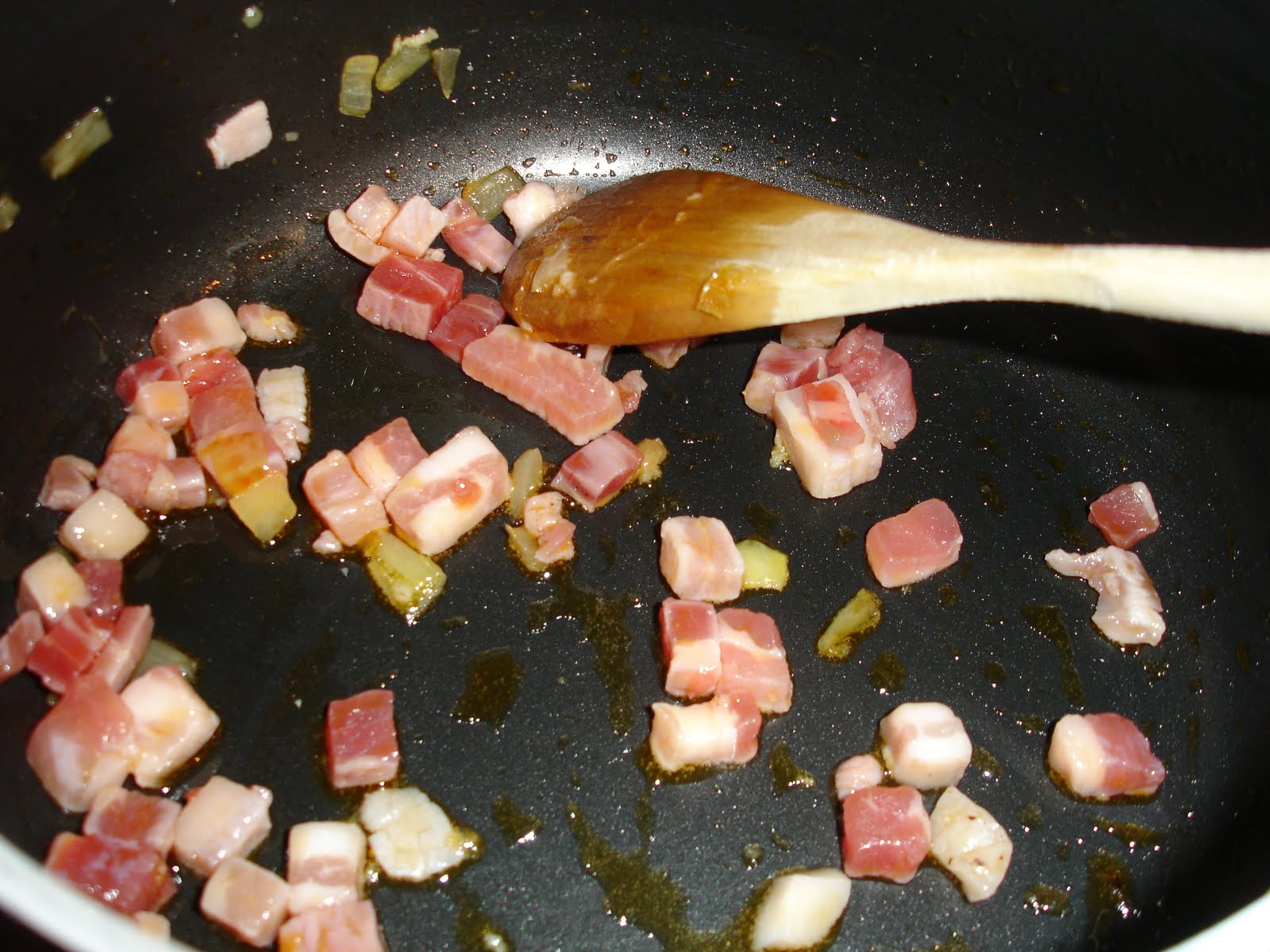
Next, fry the Pancetta until coloured, about 5 mins. Remove from the pan. Put with the other cooked ingredients.

By this time the pan will have a good flavour base, time to seal the chicken so the skin is beginning to go golden brown. Remove to a different plate.

Now return the onion, garlic, Pancetta and Chorizo to the pan. Add the tomatoes and herbs, and cook for 5 minutes – to get the flavours to combine and to start breaking down the tomatoes.

Add the saffron and hot water and mix, and then add the chicken and pork. Mix well, and add the chick peas. Pour the stock all over.

I cooked my Cocido in a slow cooker, meaning I gave it 8 hours on the slow cooker after the above steps were taken.


You may not have a slow cooker, or want the fuss. In which case you can always use a cast iron casserole dish for the above steps, and then put in the oven at perhaps 160 to 170°C for the remaining cooking. It will need at least 2 hours. Please note that raw soaked chick peas may not cook in this time, so you may want to used tinned instead.


Just when the Cocido is nearly ready, put a small pan of water on the hob for the pasta. As I said above, the authentic accompaniment is fideo pasta. However, I couldn't find this, so I used capelli corte (short cut angel hair pasta) which was a good substitute. Cook until al dente, then drain.

Put the pasta into the bottom of your serving bowl. 

Then serve the gravy with a good mix of the other ingredients and crusty bread on the side.