Sadly, there are many classic Indian dishes which, frankly, I don't have a Scooby about. (Scooby Doo = clue, in Cockney rhyming slang. Anyone not familiar with this somewhat tongue-in-cheek vernacular can consult http://www.cockneyrhymingslang.co.uk/). My mum is an amazingly accomplished cook whose Indian food is as tasty as she is modest about her abilities. No, she isn't one of those Indian mothers who says they aren't a great cook secretly fishing for praise. She seriously does not think her abilities equal that of my dear departed gran, her mother, and is geniunely taken aback by praise (and equally so an empty plate after second servings!). But I never managed to achieve her nouse and intuition for Indian cooking.
I realise some of you will have heard stories, which you have decided can only be apocryphal, about gifted Indian home cooks who never measure anything out. Let me assure you, my first 21 years were spent watching the reality. Mum never measured anything out. Her superb instincts guided her in every delicious dish she made.
All of which leaves me in big trouble. I want to eat the food of my childhood; comforting dahls, satisfying gravy-fest curries, spiced stir fried veggies..... One of my students recently said that this food was, to her, 'Soul Food'. She's right, it is my Soul Food too. Food which connects me to a heritage I have largely missed out on due to my pathetic inability to absorb or understand Hindi or Bengali. But, like my grasp on Bengali, my grasp on Indian cookery is shaky, inaccurate, sometimes hamfisted or overly heavy-handed.
Recently, me and Him Indoors went out for a meal in Shoreditch. We arrived in town early, hoping to scope out a bar for a pre-dinner drink. We found ourselves very close to Brick Lane. The spices started calling me, and I asked Him Indoors if he wouldn't mind if we walked along Brick Lane. We'd arrived in plenty of time for our booking, so off we went. And then I found it..... BANGLA CITY!

My parents are Hindu Bengalis. They are a people who come essentially from the geographical area which is now Bangladesh. In 1947 all non-Muslims were advised to leave what was soon to become East Pakistan. My mum's and dad's families didn't hang around and moved into India. Many atrocities occurred on all sides of the 1947 partition. No one has the right to any moral high ground. What is clear is that many ordinary people had to give up homes inhabited for generations for an uncertain future in a new land.
So my culinary heritage is Bengali/Bangladeshi. Their food is spicy, but not fiercely hot. Often juxtaposing spice with sweetness. There is also a tangy, spicy sweet-sour flavour which is very prized. It is a subtle mix of flavours which, frankly are easy to bodge. I felt I needed a helping hand. And Bangla City promised to provide it.
 |
| My Cheat's Ingredient: Spice mix |
My mum makes what she calls 'Aruhar Dahl'. This is a dahl (lentil stew) made up of Toor Dahl. Some may not be familiar with Toor Dahl. Chances are you are familiar with Masoor Dahl, a dehusked and split orangey-red pulse which is about 3mm in diameter. Or you may have had Chana Dahl (made of split chick peas). Some restaurants serve the delicious Punjabi Madhi Dahl/Makhni Dahl (Madhi means "mother's", Makhani means "butter"), made of black (urid) dahl. Toor Dahl is made from Yellow Pigeon Peas (Cajanus cajan), which are dehusked and split. They can be bought dry, but are often coated in oil to preserve them for long storage and shipping. You will see that I bought the oily variety. This is available in Indian grocers shops, but larger supermarkets, particularly in areas where a lot of people of Indian origin live will also stock packs.

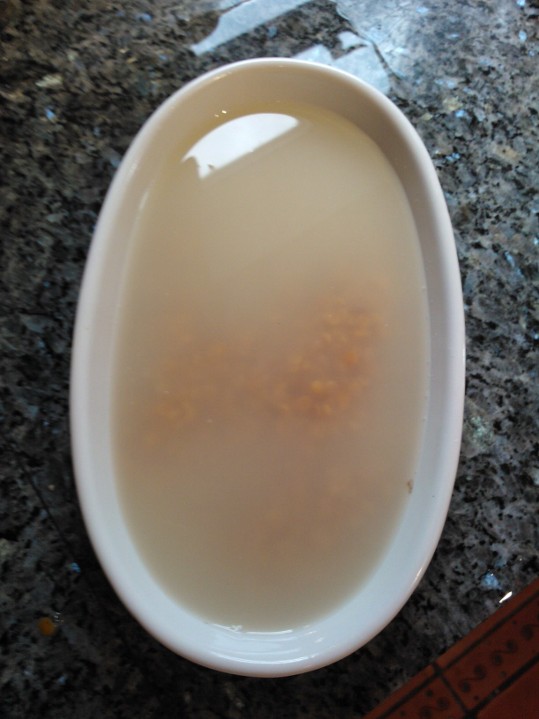
I know what you're thinking; "Oily lentils? Ugh! I thought pulses were supposed to be healthy!" Don't worry; you will wash the oil off. Although you will need some patience. I found that it took 2 short soakings and 2 thorough washes to get the oil off. You've got to get your hands in and move the lentils around under running water, but you'll find that you'll get to the point where the water is pretty clear.
 |
| The great unwashed? This is what the dahl looks like straight out of the packet |
 |
| After a 5 minute soak and some agitation |
 |
| After the first rinse through |
 |
| Second soak |
 |
| After the second rinse: time to start cooking! |
When making Toor dahl, it is customary to add some fried asafoetida (or hing) at the end of the cooking. Hing comes from the root of Ferula assafoetida. When I tell you what some of its common names are, namely devil's dung and stinking gum, you might realise that one of it's most characteristic features is its strong smell. But please don't worry, the hing will be cooked, and its smell will mellow.
The recipe on the pack reads thus (copied exactly):
"Boil 200g Arhar Dal in 800ml. water till tender. Fry 80g chopped onions in 40g cooking oil till golden. Add 100g chopped tomatoes and 15g Arhar Dal masala. Stir for 4-5 min. till it becomes paste. Take one part of boiled Dal and add to it. Mix well. Then transfer it to the remaining boiled Dal. Check seasoning. Simmer for 5 minutes. Dress with chopped coriander leaves & serve with Rice or Roti."
Perhaps not expressed as well as it could be, but the method is fairly clearly set out. This is basically a dahl with a tarka made of onion, tomato and the spice mix. I've made lots of Tarka Dahls in the past (Tarka is the fried spice mix thrown into the lentils at the last minute, not the type of pulse used). I have posted my own recipe previously (link here), but I have never made a tomato tarka. So I was curious about the outcome. But before we get to the verdict, let's review the preparation and cooking process.
As I have said already, you need to wash the lentils. Now you're read to start cooking.
The directions don't tell you how long it will take until the Dahl is 'tender'. Well, that appears to be about an hour. Mine took 1 hour 5 minutes. Just so you know. Put the pan on a low simmer, and then do something else. Set your laptop up in the kitchen and either get some emails done, or waste time (sorry, I mean browse) Youtube or Facebook. But leave youself 5-10 minutes for chopping the onions and tomatoes.
This is what the tender Dahl looked like:

Tarka time! I fried the onions for 5 minutes before I then added the tomatoes and masala mix. I'll confess that I found measuring out exactly 15 grammes of spice quite difficult. I wish they'd told me how much masala in teaspoons or tablespoons. My scales didn't initially register the weight of the spice, and it took a couple of goes to get it right. (Request to recipe writers; domestic scales are not very good for precise weighing of small weights lighter than 25g/1oz. Please use spoon measures instead!)


I then took some of the cooked Dahl and put it in the Tarka pan. The contrast of colours is amazing.

Mixing the two up causes the Dahl to darken and go a mellow browny-orange. The texture thickens as you mix. And the smell is very inviting!

Time now to put this mixture in the main Dahl pan. Look at the difference in texture and colour.

The two halves of the Dahl need thorough mixing to disperse all the flavours of the cooked spices. Get your stirring arm going!

Because I really wanted to see what flavours the spice mix would give to the lentils, I did not add the chopped fresh coriander at the end. Chopped fresh coriander is not to everyone's tastes, but I personally love it added to cooked Dahl. It freshens and lifts the taste in a way which makes it worth the hassle. If you are adding some, you will need a good handful. I find when I am cooking Indian food, the supermarket bags of coriander leaf are a little too stingy for my liking. I go and buy a bunch from a local ethic shop. I get much more leaf for much less coinage.
My verdict: this spice mix delivered a very satisfying result. It was quite hot, and for me, did not need any more heat. It has an authentic balance of flavour. Although the phrasing of the recipe could be improved, it is very effective. The texture added by the onion and tomato tarka gives the Dahl body. Him Indoors likes more chilli than me, and was suitably impressed with the kick of this dish. We will be making it again, when I next have time for a curry-fest (it is a shame that Indian food can be so time consuming to make!).
The masala mix contained coriander, red chilli, salt, mustard, turmeric, cumin, onion flakes, tamarind, dry ginger, garlic flakes, cloves, nutmeg, curry leaves and asafoetida (hing). If you have space to store another carton of ingredient, I would say it warrants some cupboard space. Getting the balance of spices right can be tricky, and this stuff takes the guesswork out of things.
If you want to try to make an authentic version from scratch, here are a few recipes:
http://www.mamtaskitchen.com/recipe_display.php?id=10367 (Very helpful instructions for both pressure cooker and ordinary cooking, and a simple tarka. Exactly what you'd expect from Mamta, the mum of Kavey of Kavey Eats fame, one of my favourite food bloggers)
http://www.manjulaskitchen.com/2007/02/16/toor-dal/ (Slightly different from the Bengali version)
As ever, if any readers have their own recipes, techniques or feedback, please let me know! I am always pleased to hear from you.


