Showing posts with label rice. Show all posts

Saturday, 16 June 2018

Greek style pilaf with saffron, pine nuts and sultanas


I recently made a recipe for a Saffron infused Greek chicken stew from Rick Stein’s Long Weekend’s series and book. The stew is very tasty as it is, with the warming richness of saffron and paprika combining with on the bone chicken and pitted prunes to make a satisfying braised casserole. 

However, I personally found the pilaf recipe to be a bit too basic. The proportions of the ingredients to rice did not seem right to me, and if I wanted something plain, I would have served up plain rice. I also thought the onions needed proper cooking before cooking the rice. I like my onions soft before adding other ingredients.

So this is my tweak on Rick’s rice recipe. I am posting it here after receiving a request for the recipe on social media. I hope it meets with your approval. 

You can serve it with any Greek, Turkish or Cypriot stew, casserole or guvec. I am having a lot of fun experimenting with guvec recipes; with chunks of meat or with handmade kofte. 

The food of the eastern Mediterranean is underrated. Some people think it is “just kebabs”, as if even a carefully marinaded and perfectly barbequed skewer of meat is just a simple thing to throw together with no skill or technique. This is a food culture which deserves so much more recognition and respect. 


Greek style pilaf with saffron, pine nuts and sultanas

Serves 2

Ingredients: 

15g unsalted butter (if you choose to use salted, please be careful about using stock, it could end up tasting very salty)
150g basmati rice
20g pine nuts
Half a small organic onion, very finely diced
20g sultanas (Rick says you can also use currants, but I prefer sultanas or raisins. The juicier the better!)
1 bay leaf, fresh or dried, whichever is available
A couple of strands of saffron (5 or so maximum)
300ml hot water or stock (chicken or vegetable, as you see fit)
Salt to taste

Method:

1.       Decide if you are using hot water and stock. Whichever you decide, infuse the saffron whilst you prepare the other ingredients.  

2.       Lightly toast the pine nuts in a dry frying pan on a low heat. Be careful, these burn unbelievably quickly!

3.       Melt your butter in a small saucepan on a low heat. Don’t let it burn. (Please use a saucepan with a lid, see below.)

4.       Then add the diced onion, stir, raise the heat to medium-low and fry for at least 10 minutes, until softened.

5.       Add the rice, coating thoroughly with the buttery onions. Keep stirring over the heat for 1-2 minutes. Add the bay leaf. 


6.       Add your hot water or stock with the infused saffron strands, mixing thoroughly. Turn the heat up to medium-high.

7.       When you can see the liquid is boiling, turn the heat back down to low or medium-low. Put the lid on. Simmer for 10-15 minutes. If you need to check at 10, 12 and 15 minutes.

8.       When the rice is beginning to approach tasting of a cooked texture, add your toasted pine nuts and sultanas. Stir thoroughly. Cook for another 5 minutes. 

9.       Taste for the salt level, adding salt if needed.


10.   Serve with your favourite stew, guvec or casserole.

Saturday, 16 February 2013

Turkish 'Kebab' Rice


Turkish food is unfairly underrated in the UK. Most people seem to think that it is 'only' about kebabs. This is unfair for two very fundamental reasons. Firstly, because Turkish food is about so much more; the superb sote dishes, such Guvec (casseroles and stews which are full of flavour); their superb take on pizzas (also known as Pide); one of my personal favourites, Lahmacun and their exceptional sweet and satisfying puddings (think sutluc, baklava and kadayif). Secondly, Turkish food is healthy and nutritious; all their meals are perfect balances of everything you need. And frankly their marinaded meats are to die for! If I were to say French food was only about creamy sauces, you'd tell me that I was incompletely and unfairly generalising, and you'd be right. Yet when it comes to Turkish food, these gross generalisations seem to be tolerated.

When you eat out at Turkish restaurants, the main accompaniments are often salad and rice. This is a great combination, as you get fibre, vitamins, minerals and a dose of carbohydrates to keep you going along with your meaty protein goodness. It's a truly balanced meal, and one that is fairly low in fat since the meat is usually grilled.

If you have ever wanted to make the rice accompaniment, I have been experimenting with getting it right for some time. I first tried to write a recipe for it when I posted my Turkish Cypriot style lamb stew recipe (here http://snigskitchen.blogspot.co.uk/2012/08/turkish-cypriot-style-lamb-stew.html). But it turned out to be a bit hit and miss, depending on the level of heat from the hob. Another issue was that I had no proper idea of how much oil to use (too much affects the texture of the dish. And there was some fragrance and flavour missing. 


So here is a revised version. You need a saucepan with a well fitting lid, and you need to use a ring on the hob which can be turned down to a very low heat.

Turkish Basic Pilaf (AKA 'Kebab' Rice)
Serves 2


Ingredients:

2 heaped tablespoon or around 30g orzo pasta (alternatively capellini corte)
130g Lux Baldo rice
1-2 bay leaves, dried
1 tbsp olive oil
250g or ml water

Method:

In a small saucepan (for which you have a good fitting lid), heat the olive oil. You only need a medium heat.

Add the pasta. 


Stir frequently and fry for 2-3 minutes, until the pasta begins to toast and change colour. Turn the heat down if you think the pasta will burn. Or take it off the heat completely. You do not want the pasta to turn more than golden brown. 


Now add the rice and bay leaves. Coat well in the oil and mix the pasta up thoroughly whilst stirring for another 2 minutes.


Now add the water. Bring to a light boil. Turn the heat down to a very low simmer. Mix all the ingredients very thoroughly. Put the lid on the pan. 


Cook with the lid on for 15-17 minutes. You may need to check it after about 10 minutes to stir. You want to ensure the rice at the bottom of the pan does not catch and burn.

After the main cooking time, check the rice is cooked and the water absorbed. 

If not, take the lid off, put the heat on the lowest possible heat setting you can manage, and stirring frequently, heat for a further 2-3 minutes.


Check that the rice is cooked; it should be by now.

Serve with grilled meats or Turkish stews and salad.


Tuesday, 13 November 2012

Rice and Peas Freddie Stylee: A Guest Post from Freddie Patmore


I am delighted to host one of my series of Guest Posts. This one is from a friend of mine, Freddie Patmore. Freddie is a woman of considerable talent. Warm and funny, she is awesome company. Her interests are wide, ranging from mathematics, food, film and craft. She is also one of the nation's leading authorities on knitting, the creative and artistic skill which is only recently getting the recognition it deserves. 

Freddie is the co-author of "Knit Step by Step" and "The Knitting Book", both published by Dorling Kindersley. The Knitting Book is considered something of a Bible to knitters and contains some of the clearest explanations of techniques available; all supported by superb diagrams and photographs. It's like having the wonderfully enthusiastic Freddie herself standing over your shoulder telling you 'Watch out! You're about to drop a stitch!'. 

Freddie works as a consultant at Rowan Yarns and can sometimes be found on the 4th floor of John Lewis Oxford Street. So lovely is she that if you have any questions or issues about your knitting, or even your crochet, she will take time, trouble and heart to help you. She is a rare and lovely person. And she is the brains behind 'Knitting Rocks'; a project to get younger people into this most relaxing and productive of creative crafts.

Freddie has been an enthusiastic cook for some time. She invents her own dishes and experiments with food all the time. But it was when she declared she had her own 'family recipe' for Rice and Peas that I had to ask her to help me by providing a guest post. Being the kind, sweet and amazing person she is, it was emailed to me within 12 hours of asking. 

If you are interested in Freddie's writing (published in her full name Frederica Patmore) then I would refer you to the following sites:

Oh, and before any cynics say 'well, she only provided the recipe so that Snigdha would post links to her books.' I say not a bit of it. I wanted to tell you about Freddie and her many talents, and decided to do so without telling her. Frankly, she would actually be jolly embarrassed that I've done so. (Sorry Freddie! Please forgive me! But you hide your light under a big woolly bushel, and it is high time it shone for the world to see!)

Anyway, this is something for Freddie and I to work out beyond the confines of the internet......

So I say, over to Freddie:

With icy conditions fast approaching, sometimes it's time to break out the big guns. Serious soul, comfort food, rice and peas. For me an excellent accompaniment to grilled spiced meats, curries, or great on it's own.

My relationship with food has always been a bit of a unique one I feel. With family members from Ireland and Guyana, you end up with quite a mixture! I boast my fishmonger uncle and my Dad who took cooking lessons in his late thirties to improve his cheffery proudly. For my 21st birthday I sent a notebook around the country to all my family members and asked everyone to contribute one recipe! Even my little sister, who at the time was 9, chipped in. I now go about adding to it every now and then. And this tweak on a classic has been in there for quite some time now!

This is a warming dish, relatively good for you, very filling, and dairy free for people like me who can't enjoy cows-milk! Creamy risottos and dauphionoises are a no-no, but this doesn't make a half bad substitute.


Rice and Peas Freddie Stylee! 
Serves 4, comfortably!

Ingredients
1 1/2 mugs long grain rice, washed the day before and dried out mostly
1/2 can kidney beans
Fistful of spring/salad onions, chopped
1/2 can low-fat coconut milk (make sure you shake it up before opening it!)
Dried Thyme
One small onion, finely chopped
2 hefty garlic cloves, crushed
Powdered Ginger
A chilli of some description
One bay leaf
Vegetable oil
Chicken Stock
Cumin/coriander/black onion/mustard seeds (optional) To taste.

Heat a generous splish oil in a large saucepan, add onion, crunchy spring onion pieces and spice seeds, if using, and fry gently until softened. Save the greener bits of the spring onions for later.

Add the rice, thyme, garlic and ginger and fry on a low heat, stirring regularly, for about 3 minutes, until the oil has coated the rice completely.

Add 1/2 chicken stock, 1/2 coconut milk fluid until the rice is covered over by about an inch. Chuck in a hefty pinch of salt. Don't be shy, these are big servings and you have lots of beans to season. Add the beans now, and a whole chilli, pierced, or some crushed up chillies. Just a sprinkle.

Simmer until rice is cooked and tender, stirring occasionally. Cover and remove from heat, leave to rest for about 5-10 minutes.

Stir in remaining spring onions and serve for a hearty, wholesome warming dish. Delish! 

Tuesday, 2 October 2012

A Taste of Africa: Cooking class organised by Rainbow Tours, Open Kitchen


I am pretty international about my tastes, but must confess that other than a small amount of experience with mainly north African food, I am pretty ignorant about African food, ingredients and cooking techniques. I'm not proud of it, I am admitting it since I always do my best to be honest.

I was invited a few days ago to a cooking class which explored Madagascan and Tanzanian food. It was organised by Rainbow Tours, who decided to run this session for food bloggers to celebrate winning the title of  ‘Tour Operator of the Year 2012’ by the readers of Food and Travel Magazine.

The evening began with wine, sociability and canapes. The drink flowed freely. Our nibbles, all with an African flavour, included slices of roasted sweet potato and plantain topped with a spiced peanut puree, fish croquettes, and plaintain chunks with salsa. 

The staff from Rainbow Tours circulated and were hugely knowledgeable and fired up with enthusiasm about pan-African and ethical travel. They were the first company to really pioneer responsible travel in post-Apartheid South Africa, as a direct result of (then) President Mandela inviting travellers from around the world to visit and share in the momentous changes in that nation. Diane from Rainbow Tours was great fun and I had a super time chatting to her about how easy it is to travel in Africa and how good the food can be. Here she is, just after her introduction to the session:

Our instructor and tutor for the evening was Chef Attoma Mandji, and the event was at Hoxton's Open Kitchen. Chef Mandji has worked in well-known restaurants such as Chez Gerard, Harvey Nichols, Conran group restaurants with Chef John Torode and People’s Palace with Chef Gary Rhodes.  More recently, Chef Mandji has turned his attention to teaching, and he teaches cooking skills at Hackney Community College, educating the new generation of chefs and catering professionals.

Chef Mandji demonstrated two dishes, which he then assisted us in making for ourselves. We made Romazava Vary (Malagasy Beef with Greens); a dish from Madagascar, and Samaki wa Kakuango (Steamed fish with fried onion salsa); a Tanzanian dish.

Here are the recipes:


Madagascar was formerly known as the Malagasy Republic, and its people still often refer to their culture and society as 'Malagasy'. There are many ethnic groups inhabiting this unique and vibrant island nation. They recognise themselves primarily as either 'Highlanders' or 'Coastal dwellers'. There are 3 main 'Highland' ethnic groups; the Merina, Sihanaka and Betsileo. The Coastal peoples show greater ethnic and cultural variation, with 17 recognised main cultural groups. Being such an ethnically and culturally diverse nation means that Malagasy food reflects these traditions. Their cuisine draws together these varied influences to make a culinary portfolio which is tasty, flavoursome, but not highly spiced.

I learnt that rice is the main "staple" ingredient of Madagascan food, and is the main energy source for breakfast, lunch and dinner. Zebu cattle are the traditional source of meat, although beef is a popular choice for traditional stews cooked over an open fire. Which is just as well, as I don't think sourcing Zebu for our own cooking efforts was going to be easy!

The first dish we made, Romazava Vary, like so many important dishes around the world, can vary from house to house and family to family. However, the dish is usually made in a single cooking receptacle and is made with beef (or Zebu) with some form of greens. Savoy cabbage, spring greens or spinach are all acceptable, provided the leaves are chiffonaded (finely sliced). The name reflects the way in which the dish is cooked; Ro (soup) Mazava (clear) and Vary (rice). It is meant to be a saucy, stew style dish. A one-pot meal which is designed as comfort food; sustaining, hot and filling. This is Chef Mandji’s bubbling away:

We received the demonstration of this dish and started cooking it first, since it is quite time consuming. My kitchen partner was none other than the lovely Amy from http://londonfoodadventures.tumblr.com/. I don't know how I came across to her, but I liked her straight away. No-nonsense, warm, fun and full of energy, I knew I had fallen on my feet. The relationship between chef and sous-chef is an important one, and thankfully she was happy to be a benign and kind chef! And I did my best to be a competent sous. 

Whether I managed this or not, you'll have to find out from Amy!

We were lucky that with the Romazava Vary, none of the cooking techniques were in themselves very difficult, but enough time needs to be left for the beef to cook slowly in the stock base. Later, when the rice is added, it needs sufficient time to become tender and cooked.

This was our effort at Romazava Vary , still simmering, whilst the rice was cooking.

And this was our finished dish:

Our second dish, Samaki wa Kakuango, as I have said above, is from Tanzania. Tanzania in East Africa, has a coast on the Indian Ocean. Needless to say, this vast length of coastline along with the extensive freshwater coast of Lake Victoria, means that fish dishes are a fundamental aspect of Tanzanian cuisine. Interestingly, meat is more of a rarity. I learnt that cattle are reared primarily for dairy products. As such, meat is a 'treat', eaten on high days and holidays. 

Samaki wa Kakuango is a dish commonplace across East Africa, despite being a traditional Tanzanian recipe. It is interesting that steamed fish does not appear to be popular in European cooking, yet is found across China, the Far East and Africa. The fish is usually steamed whole to keep it moist and soft, with aromatics such as chilli and garlic. A salsa style topping is made from fried onions and tomatoes to add moisture, flavour and provide a variation of texture. The fish and topping is served rice and greens. We first had to make the chilli garlic rub, which we liberally spread over the fish:

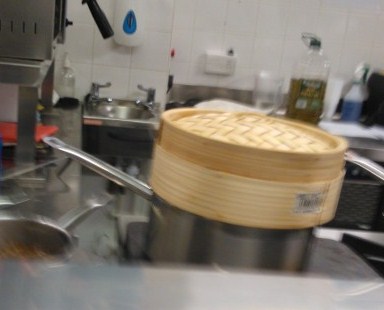
Owing to time constraints, we had to cook our fish in the oven, although we did see Chef Mandji’s results cooked in a large bamboo steamer.

Here is the finished dish:

Both of our dishes were very enjoyable. The beef was tender and juicy, and cooking the rice in the same pot lent it all the flavour of the beef, aromatics, tomato and stock. The fish (we used sea bass) was cooked perfectly, and I am sold on the idea of serving it with a salsa style topping.  It was a pleasure to learn something about a food heritage I had no knowledge about. Chef Mandji is a patient and kind tutor, and his assistant was full of useful advice.

In the interests of fairness, there were a couple of glitches; we were never provided with the green peppercorns for the beef dish and some of the ingredients were provided to us late. However, the Open Kitchen is a small charity, whose function is to train local people, often from disadvantaged backgrounds, the skills required for work in the catering industry. So it is difficult to be too hard on them, and none of our food suffered for these issues.

I love travelling and when I am travelling a major highlight is sampling the local cuisine. I must say that my curiosity about exploring Africa in all her cultural variety has been given a nudge in the right direction. The Rainbow Tours brochure has so many amazing destinations and itineraries, I feel most inspired.

The next Taste of Africa cooking class covering the food of Madagascar and Tanzania will be at the Open Kitchen on Friday 21st November. If you want further details, their website is: http://www.openkitchen.biz/
Rainbow Tours arranged the cooking class for myself and a number of bloggers. I am very grateful for their kindness. They have hosted information about the event they organised for us here: http://www.rainbowtours.co.uk/taste-of-africa/