Thursday, 27 September 2012

A Favourites List for September 2012

Hello everyone!

The new academic year has started and I am welcoming my new students. Life is hectic, but joyful. I've met so many young, interesting, exciting people full of life and promise. It is amazing to be a small part of helping them reach their potential.

The downside is that I've not had as much time available to blog as I would have liked.

I hope you will forgive me and I also hope you will enjoy this Favourites List, which I hope will become a monthly feature here at Snig's Kitchen.

Blogs worth following:

Canapes from Skylon
Recipes:
http://ethicalchef.co.uk/recipes/ (Great source of inspiring vegetarian recipes)
Heston Blumenthal's now legendary Meat Fruit

Food articles:
Homecooked Maccaflower Cheese


Cooking "HOW TO DO..." advice:


Healthy eating for men and women:

Other articles:

Homemade Turkish inspired Lamb Stew

Books:
Room  - Emma Donoghue
Miss Masala - Mallika Basu
The Etymologicon - Mark Forsyth

Music picks:
The Flaming Lips - Yoshimi Battles The Pink Robots
Kraftwerk - Computer World
Alabama Shakes - Boys and Girls
Richard Hawley - Standing At The Sky's Edge (see also Mercury Prize shortlist below)
Emile Sande - Our Version Of Events
Check out the Mercury Prize shortlist: http://www.mercuryprize.com/

Sunday, 23 September 2012

Recipe Road Test: Mallika Basu's Chingri Malai Curry

As I have indicated in past posts, my parents are West Bengal Bengalis, coming from the east of India. And as I have mentioned before, much as I love their wonderful culinary heritage, I've not been gifted with the skill and judgement to cook their food.

So when I discovered Mallika Basu's book "Miss Masala" I was pretty pleased. Not only is this a book attempting to show how good, tasty Indian food does not have to involve slaving away in the kitchen, but Basu is of Bengali descent too!
It turns out that Mallika Basu was born in Kolkata (formerly Calcutta). She came to the UK aged 18 to study, and has lived here ever since. Her journey into culinary literature started off as a blog detailing her experiments with simple, fast Indian cooking. After her studies, Mallika carved out a successful career in PR, and is now a Associate Director for a London PR Consultancy. 

Her book is one of the most useful Indian food books I have seen in a long time. What is special is how it takes the reader/cook through dishes, explaining the ingredients and techniquest, building up the level of difficulty as it goes. It's like a cookery course in book format. In addition, the anecdotes about reconciling the demands of work and a busy social life to find the time for making these dishes are humorous, written with a light and knowing hand. It made me feel like we were co-conspirators, and that I wasn't alone in wanting a rewarding life which also allowed for good food at home.

This is my test of her recipe for  I couldn't find it on her recipe on her blog (which I do recommend) http://www.quickindiancooking.com/ so I am posting a picture of the recipe from the book here: 

Chingri Maach is Bengali for prawns. The ones you can get in West Bengal and Bangladesh really have to be seen to be believed; they are such whoppers, you'd think someone got confused and served you lobster instead!

One ingredient you may not be familiar with is Mustard Oil. This is used very commonly in Bengali cooking. So commonly, in fact, that I found my bottle in Tesco, of all places! You will find that supermarkets in areas where lots of Indians live will stock it. If not, then your local Indian grocery shop should sell it. 


The first step of the recipe calls for making a curry paste. So I had to start by preparing my paste ingredients. 
Then they had to be mashed up into a paste. Stupidly, I thought the blender attachment on my food processor could manage this task. But the small amount of ingredients meant the blades couldn't get a good purchase on all the stuff. 
 
So I had to carry out a small amount of improvisation. I'm not unused to this. Often it's because I've not prepared properly. Or I've made a similar miscalculation. Still, I can't complain, since I've nearly always been able to get myself out of the whole I got myself into. 

I found that by shaking the blender vigorously from side to side and pushing the unblended ingredients back down into the blender as I went, I managed to blend the cubed ingredients into a paste. I had to blitz, stop, mix, push down, blitz, and then repeat again. (Word to the wise: use the food processor part of the machine! Don't waste time and effort!!)

Obviously, none of the above is the fault of the author of the recipe, Mallika Basu. It is all mine. As I've often said, I make the mistakes so that you don't have to!

Eventually, I got my curry paste done. And fragrant and well textured it was too!
  
Next came the frying of the whole spices with the sugar. This is a picture of the spices at an early stage of cooking:


Here you can see the caramelisation of the sugar occurring. As you can see, the sugar is the brown coloured (caramel) droplets in the oil.   

Then the paste has to be added. This does have a tendency to spit at you, because the paste ingredients contain a lot of water and the oil is rather hot. Be careful and hold your body back away from the pan if it starts to get nasty. Keep calm, and try not to worry.

As you cook the paste, you will need to keep it moving, or it will catch and stick to the pan. Put some good music on and bliss out, or put your phone on speakerphone/hands free and have a chat. Just don't leave the pan unattended!

Eventually the paste will change colour. 

Then it is time to add the sauce flavour base: the chilli, turmeric and chopped tomato. You will see the colour changes almost as soon as you have mixed it all up.

As Mallika says; here is the tricky part of the recipe. You need to mellow the spices and cook it all gently without burning. Put the pan on the smallest ring of your hob, and turn the heat really low. Burnt garlic and ginger will ruin the taste of the overall dish. Keep an eye on the pan and stir regularly. You will be able to smell the contents change in character. At the beginning you will be able to sense the ingredients; you will get tinges of the smell of each. As you get to the point where they are cooked, they will meld together. 
We then have to add the coconut milk. 
This will need very thorough mixing, to ensure all the flavours and smells permeate the coconut milk thoroughtly. You will not want unmixed sections, as these will taste bland and uninteresting.


Then add your prawns. Frozen prawns must be defrosted beforehand, or you will have to radically increase the cooking time.

After the allotted cooking cooking time, your prawns will be perfectly cooked, and will have taken on the flavours of the sauce

Serve with boiled/steamed Basmati rice.

Verdict: This did taste like an authentically Bengali curry. The gravy is flavoursome and goes well with rice, but equally would compliment breads such as paratha or chapati. The dish has balanced 'spicy' taste, but not mountains of heat. To me, "spice" is not about heat alone; it is about the tones of classic Indian spices which creates tones, reflections and counterpoints. The chilli powder did provide some heat, but it was subtle and cooked into the sauce in a very pleasing way. Fans of vindaloo and phall may want to either up the amount of chilli powder or substitute for 2 slitted or dried chillies added in at the stage where the coconut milk is added. Even though the amount of sugar added is small, it does provide a sense of sweetness which permeates the dish beautifully. It is a quintessentially Bengali element to the finished dish. This is a highly effective recipe which is in places work intensive, but that the work rewards the cook in the final result. 

Thursday, 30 August 2012

Anniversary dinner @ Dinner: A picture post

Him Indoors and I very recently celebrated our 2nd English Wedding Anniversary. You see, we had 2 weddings. For some people, this could lead to confusion and panic. After all, that is two cards which have to be bought well in advance, two dates which have to be remembered on pain of death! However, we have found this is an excellent excuse for having two BIG meal blowouts a year! Our 2nd Indian Wedding Anniversary was celebrated at Le Petit Maison, the superb Southern French restaurant which proudly declares "Tous célèbres ici" (everyone is famous/a celebrity here). So following that wonderful meal up was always going to be a challenge. We decided to haul out the big gun; Mr Heston Blumenthal. 

I've always had a soft spot for Heston. Maybe it's because I grew up in Heston, maybe it is Heston's utterly driven, borderline geeky pursuit of food perfection. I don't know. I always enjoy watching him create his masterpieces on TV. Especially his brave attempts to construct food equipment from the most unlikely objects. So when Him Indoors said he had managed to book us in to Dinner at the Mandarin Oriental Hotel, Knightsbridge, I was delighted. 

We arrived, and the place was animated and happening. It only got busier as our time there went on. This place seems to be a magnet! Tourists, businessmen, family groups and couples of all ages and races were there. It would appear that Heston's reputation and appeal has transcended all boundaries.

What did we eat?

Meat Fruit is described as "Mandarin, chicken liver parfait & grilled bread" and was inspired by a recipe from c.1500. Coincidentally, it costs £15.00! But as with so much of the molecular/super-innovative food of today, the description doesn't properly prepare you for the reality. What you get is a perfect, smooth chicken liver parfait, rolled into a ball and covered in mandarin jelly. How the jelly tastes so good, and yet manages to mimic the skin of a mandarin so perfectly is probably one of Heston's biggest secrets. And if he tells you, he may have to kill you! The grilled bread is a sweet toasted brioche. My only criticism of this super dish is why only the one slice? More bread, please!  


Rice and Flesh is described as "Saffron, calf tail & red wine", and is inspired by the oldest of the Old English recipes which influences the menu at Dinner (dating back from c.1390). To put that into context, Geoffrey Chaucer was alive then. And English was not English as we know it, but was 'Middle English'. If you want to have a look at how different the language was back then, check out Chaucer's Prologue to the Canterbury Tales here: http://www.librarius.com/cantales/genpro.htm (Good luck! I studied it for A level English Literature and spent a fortnight trying to translate it!)  The dish is a slightly al dente rice dish, made from a type of risotto rice, gently flavoured with saffron. It has the creamy taste and saffron flavour of a Risotto Milanese, but the bite left in the rice is intriguing and somehow (sacrilegious as this may seem to risotto lovers) totally right for this dish. The calf tail, stewed in red wine has been slow cooked to perfection. All of which will set you back £16.00.

The Roast Turbot, inspired by a dish from c.1830, is described as being served with "Leaf chicory & cockle ketchup" and is a steep £36.00. The turbot is superb quality, and perfectly cooked. However, I was slightly disappointed with the dish as for me the cockle ketchup was overly sour and did not go well with the leaf chicory. When eaten with some of your side dish, the ketchup is mellowed. But to serve something with such a strong tang with such a lovely piece of fish doesn't quite do it for me. It was totally edible, so don't get me wrong here. 

The Black Foot Pork Chop served with "Hispi cabbage, lardo, ham hock & Robert sauce" is from an original source recipe from c.1860. The on-the-bone chop was a lovely hunk of pinky meaty deliciousness. What is Robert sauce? I don't really know. It's thymey and mighty tasty! Compared to some of the other main courses, it is pretty reasonably priced at £30.00


When it came to puddings, I just couldn't choose. The menu is varied and everything sounds superb. Thankfully, my exceptionally polite and helpful waiter suggested I went for the Tipsy Cake. This is one of the dishes which has come to be commented on by quite a few other reviewers. Based on a recipe from c.1810, it is made from spit roast pineapple, lovingly cooked for three whole hours. Actually, when you arrive, before they take you to your table, check out the glass walled area where you can see the chefs at work. You will be able to see the precision built spit, rotating the 6 peeled pineapples whilst simultaneously raising and lowering them. It's mesmerising, and you could probably watch it for the 3 hours that the pineapples take to cook. Costing £12.00, this is a dish which delights with the boozy, sweet cake which I can only liken to a brioche, but seems almost to taste of custard, complimenting the caramelised pineapple beautifully in texture and flavour. 

If you want the Tipsy Cake, make sure you order it at the same time as your meal. The brioche is baked especially for you, and therefore takes time. 

The intriguing Brown Bread Ice Cream (inspired by a dish from c.1830), really does taste of brown bread, although sweeter and more satisfying. Served with salted butter caramel, pear & malted yeast syrup and clocking in at £9.00, is a great combination of crunch and slurp. Sweet heaven. The portion could be a little bigger, but perhaps I am being greedy!

To finish off came a glorious caraway seed biscuit with a ganache chocolate pot. I think if I had been able to sneak into the kitchens I may have slipped a couple of them into my handbag! Rich, indulgent, calorific and delightful.

After all that, I needed a lovely digestive pot of green tea. Because frankly, I was stuffed! 

Dinner has a very wide selection of wines available by the glass. This means with the help of the sommelier, you can match your wine with each course very precisely. It is worth bothering with this, particularly since you are likely to pick very different flavours (some of which can be very strong) in each of your courses. We found this really enhanced the quality of our experience. There is also a cocktail menu if you are that way inclined.


A word on the sides: if like me, you've read all about Heston's special 'triple cooked chips', you need to know that these are only available seasonally. So just like the true old fashioned chippies (the ones which don't buy frozen ready cut chips), the potatoes available in the Summer are not quite the right type for chipmaking. I remember having slightly lacklustre chips in the Summer at my old local chippy, and waiting for Winter to come again, bringing the tasty chips. The poor chipmaster had to put a note up in the window when the Summer potatoes came in, so many people would complain that the chips weren't quite right. Dinner have made the decision simply not to serve chips, substituting with twice cooked fries. Just so you know!

Dinner is an amazing restaurant. It IS expensive, I'm afraid. Particularly when you start to add drinks to the bill. It is the kind of place you go to for a special occasion, as we did. It is not an every day place. But we all need things to look forward to and to which we aspire. That is where this kind of 'uber-restaurant' fits the bill perfectly. If you love your food, you'll know of great local restaurants, pop-ups, street food and market stalls for ordinary treats. Save up for a trip to Dinner and it won't disappoint. Just don't expect to make it a habit. Unless you win the lottery.

Dinner by Heston Blumenthal on Urbanspoon

Friday, 24 August 2012

Cheating at cooking: Cheat's Aruhar Dahl


Sadly, there are many classic Indian dishes which, frankly, I don't have a Scooby about. (Scooby Doo = clue, in Cockney rhyming slang. Anyone not familiar with this somewhat tongue-in-cheek vernacular can consult http://www.cockneyrhymingslang.co.uk/). My mum is an amazingly accomplished cook whose Indian food is as tasty as she is modest about her abilities. No, she isn't one of those Indian mothers  who says they aren't a great cook secretly fishing for praise. She seriously does not think her abilities equal that of my dear departed gran, her mother, and is geniunely taken aback by praise (and equally so an empty plate after second servings!). But I never managed to achieve her nouse and intuition for Indian cooking. 

I realise some of you will have heard stories, which you have decided can only be apocryphal, about gifted Indian home cooks who never measure anything out. Let me assure you, my first 21 years were spent watching the reality. Mum never measured anything out. Her superb instincts guided her in every delicious dish she made.

All of which leaves me in big trouble. I want to eat the food of my childhood; comforting dahls, satisfying gravy-fest curries, spiced stir fried veggies..... One of my students recently said that this food was, to her, 'Soul Food'. She's right, it is my Soul Food too. Food which connects me to a heritage I have largely missed out on due to my pathetic inability to absorb or understand Hindi or Bengali. But, like my grasp on Bengali, my grasp on Indian cookery is shaky, inaccurate, sometimes hamfisted or overly heavy-handed.

Recently, me and Him Indoors went out for a meal in Shoreditch. We arrived in town early, hoping to scope out a bar for a pre-dinner drink. We found ourselves very close to Brick Lane. The spices started calling me, and I asked Him Indoors if he wouldn't mind if we walked along Brick Lane. We'd arrived in plenty of time for our booking, so off we went. And then I found it..... BANGLA CITY! 


My parents are Hindu Bengalis. They are a people who come essentially from the geographical area which is now Bangladesh. In 1947 all non-Muslims were advised to leave what was soon to become East Pakistan. My mum's and dad's families didn't hang around and moved into India. Many atrocities occurred on all sides of the 1947 partition. No one has the right to any moral high ground. What is clear is that many ordinary people had to give up homes inhabited for generations for an uncertain future in a new land. 

So my culinary heritage is Bengali/Bangladeshi. Their food is spicy, but not fiercely hot. Often juxtaposing spice with sweetness. There is also a tangy, spicy sweet-sour flavour which is very prized. It is a subtle mix of flavours which, frankly are easy to bodge. I felt I needed a helping hand. And Bangla City promised to provide it.
My Cheat's Ingredient: Spice mix

My mum makes what she calls 'Aruhar Dahl'. This is a dahl (lentil stew) made up of Toor Dahl. Some may not be familiar with Toor Dahl. Chances are you are familiar with Masoor Dahl, a dehusked and split  orangey-red pulse which is about 3mm in diameter. Or you may have had Chana Dahl (made of split chick peas). Some restaurants serve the delicious Punjabi Madhi Dahl/Makhni Dahl (Madhi means "mother's", Makhani means "butter"), made of black (urid) dahl. Toor Dahl is made from Yellow Pigeon Peas (Cajanus cajan), which are dehusked and split. They can be bought dry, but are often coated in oil to preserve them for long storage and shipping. You will see that I bought the oily variety. This is available in Indian grocers shops, but larger supermarkets, particularly in areas where a lot of people of Indian origin live will also stock packs.

I know what you're thinking; "Oily lentils? Ugh! I thought pulses were supposed to be healthy!" Don't worry; you will wash the oil off. Although you will need some patience. I found that it took 2 short soakings and 2 thorough washes to get the oil off. You've got to get your hands in and move the lentils around under running water, but you'll find that you'll get to the point where the water is pretty clear.
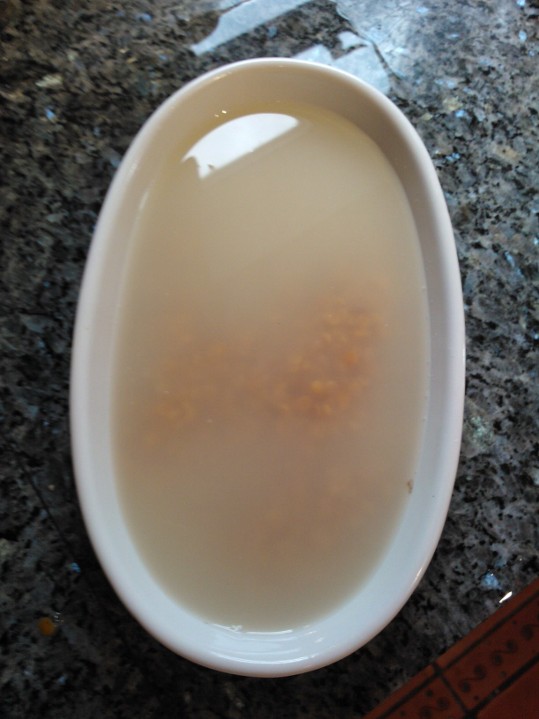
The great unwashed? This is what the dahl looks like straight out of the packet

After a 5 minute soak and some agitation

After the first rinse through

Second soak

After the second rinse: time to start cooking!

When making Toor dahl, it is customary to add some fried asafoetida (or hing) at the end of the cooking. Hing comes from the root of Ferula assafoetida. When I tell you what some of its common names are, namely devil's dung and stinking gum, you might realise that one of it's most characteristic features is its strong smell. But please don't worry, the hing will be cooked, and its smell will mellow. 

The recipe on the pack reads thus (copied exactly):
"Boil 200g Arhar Dal in 800ml. water till tender. Fry 80g chopped onions in 40g cooking oil till golden. Add 100g chopped tomatoes and 15g Arhar Dal masala. Stir for 4-5 min. till it becomes paste. Take one part of boiled Dal and add to it. Mix well. Then transfer it to the remaining boiled Dal. Check seasoning. Simmer for 5 minutes. Dress with chopped coriander leaves & serve with Rice or Roti."

Perhaps not expressed as well as it could be, but the method is fairly clearly set out. This is basically a dahl with a tarka made of onion, tomato and the spice mix. I've made lots of Tarka Dahls in the past (Tarka is the fried spice mix thrown into the lentils at the last minute, not the type of pulse used).  I have posted my own recipe previously (link here), but I have never made a tomato tarka. So I was curious about the outcome. But before we get to the verdict, let's review the preparation and cooking process.

As I have said already, you need to wash the lentils. Now you're read to start cooking. 

The directions don't tell you how long it will take until the Dahl is 'tender'. Well, that appears to be about an hour. Mine took 1 hour 5 minutes. Just so you know. Put the pan on a low simmer, and then do something else. Set your laptop up in the kitchen and either get some emails done, or waste time (sorry, I mean browse) Youtube or Facebook. But leave youself 5-10 minutes for chopping the onions and tomatoes.

This is what the tender Dahl looked like:

Tarka time! I fried the onions for 5 minutes before I then added the tomatoes and masala mix. I'll confess that I found measuring out exactly 15 grammes of spice quite difficult. I wish they'd told me how much masala in teaspoons or tablespoons. My scales didn't initially register the weight of the spice, and it took a couple of goes to get it right. (Request to recipe writers; domestic scales are not very good for precise weighing of small weights lighter than 25g/1oz. Please use spoon measures instead!)

I then took some of the cooked Dahl and put it in the Tarka pan. The contrast of colours is amazing.

Mixing the two up causes the Dahl to darken and go a mellow browny-orange. The texture thickens as you mix. And the smell is very inviting!

Time now to put this mixture in the main Dahl pan. Look at the difference in texture and colour.

The two halves of the Dahl need thorough mixing to disperse all the flavours of the cooked spices. Get your stirring arm going!

Because I really wanted to see what flavours the spice mix would give to the lentils, I did not add the chopped fresh coriander at the end. Chopped fresh coriander is not to everyone's tastes, but I personally love it added to cooked Dahl. It freshens and lifts the taste in a way which makes it worth the hassle. If you are adding some, you will need a good handful. I find when I am cooking Indian food, the supermarket bags of coriander leaf are a little too stingy for my liking. I go and buy a bunch from a local ethic shop. I get much more leaf for much less coinage. 

My verdict: this spice mix delivered a very satisfying result. It was quite hot, and for me, did not need any more heat. It has an authentic balance of flavour. Although the phrasing of the recipe could be improved, it is very effective. The texture added by the onion and tomato tarka gives the Dahl body. Him Indoors likes more chilli than me, and was suitably impressed with the kick of this dish. We will be making it again, when I next have time for a curry-fest (it is a shame that Indian food can be so time consuming to make!).  

The masala mix contained coriander, red chilli, salt, mustard, turmeric, cumin, onion flakes, tamarind, dry ginger, garlic flakes, cloves, nutmeg, curry leaves and asafoetida (hing). If you have space to store another carton of ingredient, I would say it warrants some cupboard space. Getting the balance of spices right can be tricky, and this stuff takes the guesswork out of things. 

If you want to try to make an authentic version from scratch, here are a few recipes:
http://www.mamtaskitchen.com/recipe_display.php?id=10367 (Very helpful instructions for both pressure cooker and ordinary cooking, and a simple tarka. Exactly what you'd expect from Mamta, the mum of Kavey of Kavey Eats fame, one of my favourite food bloggers)
http://www.manjulaskitchen.com/2007/02/16/toor-dal/ (Slightly different from the Bengali version)

As ever, if any readers have their own recipes, techniques or feedback, please let me know! I am always pleased to hear from you.