Sunday, 10 February 2013

Roux at the Landau


Modern dining trends are great. I am all for the new generation of restaurants with a near obsessive interest in quality and authenticity. Often inspired by the founders' travels around the globe, these establishments try to capture the essence of some of the greatest travel and food experiences. Sometimes when you go out, you want to be transported to a quintessentially Andalucian tapas joint, or a Bombay Irani cafe or a Venetian bar. These are great places to eat, and have made the London restaurant scene the envy of the world. And if our restaurant isn't the envy of the world, it is only because the world has not yet realised how awesome it is!

But I digress, as is my habit. What I wanted to say is sometimes you want a little more space. Space to relax, with a big enough table that you aren't squashed. Time enough that you can properly chat and catch up and make an evening out of a meal. When those occasions call (as it recently did for Him Indoors and I when we wanted to catch up with one of my dearest old school friends), we needed to think long and hard about where we went. We didn't want a place with a 'no reservations' policy, or who knows how long we might wait for a table? We didn't want an establishment playing music so loud you can't talk, when the whole purpose of the evening was to chat, catch up and be sociable. We wanted a place with good food, an ethos where a good experience was key, and where the service was professional; attentive yet low key. We decided, eventually on Roux at the Landau.

Roux at the Landau is located at the Langham Hotel, Portland Place, literally across the road from the BBC's iconic building near the top end of Regent Street. Thankfully, it has its own entrance, so you don't have to feel the need to explain to the dapper and exceptionally polite staff that 'err.... umm..... I'm just looking for the restaurant. I'm not actually staying here....'! The restaurant, whose head chef (chef de cuisine) is Chris King, is run overall by Albert and Michel Roux Jnr. Chris King is the protege of Michel Roux Jnr, and worked at that pinnacle of restaurant perfection, Le Gavroche, for 5 years. So we were looking forward to a special evening of food, chat and a little luxury.
 
Canape: Fresh olives, stuffed with veal
Olives are often an acquired taste and we frequently find the preserved variety are too sour or salty. These fresh olives had a mere hint of bitterness; the real flavour of the olive unadorned by preserving agents, but with a hint of fruit. The olive's texture was firm, and the veal stuffing soft and toothsome, providing a wonderful contrast. A teasing hint at the food to come. 

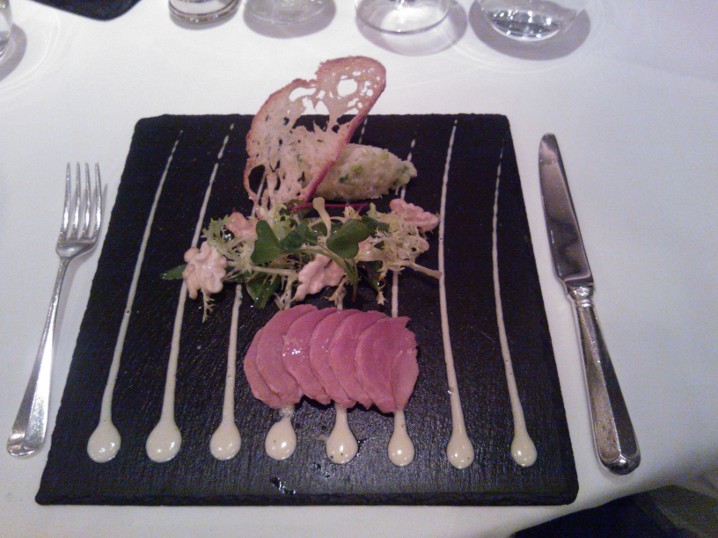
Poached duck breast with savoy cabbage 'rillettes' and walnut juniper dressing
Usually 'rillettes' means you receive a pate-like dish. Commonly made of pork, the meat is cooked in fat, very slowly with copious amounts of salt. The meat is then turned into a pate or paste by slicing or shredding and then combining it with the cooking fat. However, here the rillettes are a vegetable pate made of finely chopped savoy cabbage. The cooked duck has been finely sliced and has been gently cooked to keep its consistency and flavour. The presentation of this dish is just astonishing. It is art on a slate.


Classic salmon and scallop cervelas with shellfish butter sauce
Again, we have a traditionally French dish, given an original twist. This time, cervelas, which would usually be a sausage made of pork and beef (often with bacon), has been made of seafood rather than meat. The balance of salmon and scallop is well observed, because it would have been easy for the stronger flavoured salmon to  dominate the delicate scallop. But, we are in the hands of a master, so no danger there. The cervalas was gloriously yielding, soft and tender. The shellfish butter sauce gently reminds me of the sea; tasting "of the sea" but not at all fishy. 


Spit roast chicken with pecorino-basil gnocchi and young artichoke ragout
The chicken is one of the smaller ones; not those tasteless rapidly grown ones whose flesh is open textured and full of water. It has been roasted such that it is still moist and flavourful. The gnocchi are breadcrumbed and not quite what I was expecting. My only criticism is that I can barely taste the basil, one of my favourite herbs, evoking sunny days spent in Italy. But the artichoke ragout is gently cooked and coats the chicken and gnocchi, bringing out their textures and flavours with a complimentary flavours.

Butter roast beef chateaubriand, fondant pink fir apple potatoes and Roquefort hollandaise
Rich and satisfying, the beef is delightful. With the creamy deliciousness of the Roquefort hollandaise, this is not a dish where you consider the calorie count, but one to chalk up as a decadent treat for yourself. Pink Fir Apple potatoes are rare, overshadowed by Anya and other small potato varieties. It's a slight shame that there were not more of the actual potatoes served, since they are nutty and delicious.


French and British Artisan cheeses
First, let me show you the selection. Other than Le Gavroche (whose cheese selection takes up a table top on a rolling trolley of at least 4 feet by 2.5 feet!!), I don't think I have ever seen such a large array of cheeses to tempt the most varied palate. Oozy, young, mature, hard, soft, blue, goats milk, lambs milk, cows milk; all tastes are catered for. Onion marmalade, pickle and quince jelly are all supplied


Ice cream sundae du jour
Served theatrically in a bowl of ice, this is spectacular. Very high quality ice cream, it needs the ice to allow you enough time to eat it without turning into slush! Topped with thin, delicately baked biscuit, this dessert selection of our guest was demolished with relish.

The desserts were enjoyed with glasses of Chateau de Cerrons dessert wine. Indulgent, but it complimented both the ice cream and cheeses with its cool, sweet raisiny tones.

I didn't take pictures of the Petits Fours. The lights were fading and flash simply ruins all attempts at food photography. Besides, my dinner companions were getting more than bored on my insistence to take photos of every single dish, often more than once. I can vouch for the fact that the forest fruit jelee was intensely flavoured with fruit with just enough gelatine for firmness, the mini-palmier light with a hint of chocolate  There is a choice of coffees or a variety of teas, all of which are a very high quality. 

Turning to the service, I cannot fault it. It is kind, polite, attentive yet unobtrustive. Sometimes I find too much attention a little intimidating. And I really don't like snootiness, which I have experienced both in London and elsewhere.  Here the courses are not rushed, guests are given the time to eat, chat and settle down. You aren't faced with the next plate of food as soon as you've finished the last. This is exactly how I like it. There was no hint of the pushy and sometimes aggressive table turning which blights so much of the London high-scale market. We were not rushed in any way, even after we'd paid the bill but wanted to finish off our teas and coffees.

For such an upmarket restaurant (the dinner guest that Him Indoors and I brought along exclaimed 'Fancy!' as one of her impressions of the place), there is little pretension about Roux at the Landau. The service is unbelieveably polite but with a kindness and charm that is sometimes absent from 'posh' eateries'. There is none of the typical pressure to choose 'still or sparkling' water. Good old London tap water is brought to you without any sniffy attitude, which many London restaurants should note. We customers are already paying top banana for our meal - with wine - so we don't see any reason to pay between £5 and £9 for plain old H2O! 

Overall, my assessment is that the food, wine, surroundings and service here are amazing. It does, however, come at a price. It isn't excessive, for what you get. I just think it is a place for you to choose the suitable occasion for - then relax and enjoy in the care of experts in their field.

Snigdha, Him Indoors and our friend paid proper money - AKA pictures of the Queen - for their meal.

Roux at The Landau on Urbanspoon


Tuesday, 5 February 2013

I've won a Versatile Blogger Award!

I was very pleased when I was recently nominated for a Versatile Blogger Award by music aficionado, blogger, and all round good egg Simon Hetherington. Simon is the brains and talent behind a blog called Simon Sometimes Says, which you can find here: http://simonsometimessays.wordpress.com/
 
Simon is also one of my most constant twitter correspondents, with whom I've traded all sorts of wonderful musical inspiration and knowledge (his username is @Hethersimon, so get following!).

Details of "The Versatile Blogger Award" can be found here, including a selection of posts from other nominees: http://versatilebloggeraward.wordpress.com/

The Versatile Blogger Awards have some special rules. The nice people set it up aren't too fussy about them, since when they set out the rules on their blog have prefaced them with "If you choose to obey them". But it seems a little ungrateful to play the game without playing by the rules. 

So, I have to do the following:

- Display the Award Certificate on your website
- Announce your win with a post and link to whoever presented your award
- Present 15 awards to deserving bloggers (this feels like a lot…)
- Drop them a comment to tip them off after you’ve linked them in the post
- Post 7 interesting things about yourself 

So here is the Award, in all of its emerald glory:


Here is my list of 15 highly deserving bloggers:


Now I have to post 7 Interesting things about me:

Seriously? I have to write as many as 7? This will be tough.....

1. I am 5 foot 1. That makes me a munchkin. It also means I am the same height as reggae and dub pioneer Lee "Scratch" Perry, apparently. I have also been told I am the same height as Kylie Minogue, but I am not as enamoured of her music, so I don't like to mention it. I cannot currently confirm Prince's height, but would be happy to be as vertically challenged as his Purpleness!

2. The most extreme thing I have ever eaten was a barbequed and marinaded red ants' nest in a village in Cambodia. During the food shortages of the Khmer Rouge era, people in rural areas experimented with eating insects to ensure some protein intake. I don't recommend it, the formic acid is rather unpalatable. Worry not, the recipe will not be making it to my blog!

3. The second most extreme thing I have ever eaten was a "Hundred Year Egg" as a dare in Chiang Mai, Thailand. The nice guy at our hotel had some in his packed lunch, and thought that as a lily livered foreigner (or 'farang' in Thai), I wouldn't dare try one. Well, I did! And the strangest thing about it was that it didn't actually taste as 'eggy' as a regular hard boiled egg!

4. I am obsessed with music, from the mid 1960s to the present day. I love the Beatles, whose music is always there as a source of comfort, inspiration and happiness. The musician I most admire is Jimi Hendrix for his innovative style, mastery of the instruments and skill at incorporating finger shredding solos into songs without sounding bombastic. That his influence still can be felt in the axe practitioners of today only reinforces his standing as the greatest guitarist that ever lived. Sorry, Johnny Marr! 

5. I own a horrible number of albums, mainly on CD, but also on vinyl. I have arranged my CD collection like a record shop; alphabetical order (by artist surname) with little tabs. It sounds like I'm a librarian style neat freak, when actually I am chronically disorganised - but alphabetisation is the only way when you have more than 600 albums!

6. Although I am now a Senior Lecturer at a London law school, I am by training and trade a Barrister, and I am a member of the Inner Temple. This means that when I was formally admitted into the profession (what we name "Called to the Bar"), it was in the Temple Church, as made famous by The Da Vinci Code. Following the success of the book and film (I confess I am not a fan), the place is now a very popular visitor attraction, whereas back in the day when I was training, it was almost deserted.

7. I love food from all over the world and consider myself to have truly international tastes. However, if push comes to shove, my all time favourite cuisine would be Thai food. I love the combination of the main four flavours combined in each dish. I think their salads are flavour bombs which make eating lots of veg and having a low fat meal a doddle. Although their use of chillis and heat can sometimes be incendiary, it is never gratuitous. So Thai is number one in the Snig's charts, followed by Indian, Italian, Chinese and French making my top five.

So thanks to Simon for his very kind nomination. I am chuffed and deeply flattered!

Monday, 28 January 2013

Favourites List - January 2013

January is a difficult month. After all the festivities, fun and frivolity of the festive season are over, you have to take the Christmas tree down, pick yourself up from your New Year's day hangover and face mid Winter in all its freezing glory. Even though the Christmas tree might have taken up a lot of space, now that it is gone and you have got your room back, it's funny how the house feels bare, doesn't it?

I've been kept very busy by the day job. I've been in the thick of delivering my enjoyable but mentally taxing Large Group Sessions (that's lectures to those who still work in old money), my many fun Small Group Sessions (seminars), producing podcasts and student materials. We are also beginning to get into the dreaded Assessment Season. Feared and despised by students and tutors alike, it is now looming over us like a big, dark, big, dark...... loomy thing. See what's happened to me?! I can't even manage to write decent prose these days....

Still, here is my January Favourites list of all the stuff that has been diverting me these past few weeks. I hope you enjoy them!

The pictures this month are from my recent trip to Sri Lanka of the fishing boats in Negombo.


Blogs worth following:

http://eggsontheroof.com/


Recipes:


Proper tagine with heat diffuser and ceramic dish, Peckham style: http://helengraves.co.uk/2013/01/peckham-goat-tagine/


Up to date take on classic beef stroganoff (although I'd pass on the boil in the bag rice and would cook my own): http://www.jamieoliver.com/recipes/beef-recipes/beef-stroganoff-fluffy-rice-red-onion-parsley-pickle

One pot wonder with lamb and pasta (a real Winter Warmer!): http://www.domesticsluttery.com/2009/12/one-pot-wonder-aromatic-lamb-with-orzo.html

Know what is in your burgers by making your own: www.deliciousmagazine.co.uk/recipes/the-ultimate-beef-burgers

Vegetarian: Wild Mushroom Stroganoff http://recipes.vegsoc.org/christmas_recipe.aspx?cId=98


Interesting articles:

What is Kohl Rabi and what to do with it: http://www.food52.com/blog/5253_down_dirty_kohlrabi


It's wrong to blame feminism for the lack of cooking in contemporary homes: http://www.theatlantic.com/sexes/archive/2013/01/betty-friedan-did-not-kill-home-cooking/272518/


A defence of the recipes of TV chefs (recently dubbed unhealthy): http://www.guardian.co.uk/lifeandstyle/wordofmouth/2012/dec/18/tv-chefs-food-not-unhealthy

Alvin Leung (Bo London & Bo Innovation) on his approach to food: http://blogs.wsj.com/scene/2012/12/19/the-engineers-approach-to-food/


Books:

The Good, The Bad and The Multiplex: What Is Wrong With Modern Movies? by Mark Kermode


Music:

Akron/Family - Akron/Family

Jimi Hendrix - Are You Experienced

Ben Howard - Every Kingdom

Jack White - Blunderbuss


Saturday, 19 January 2013

Slow cooker 101 (AKA Crock Pot 101 or How to use a slow cooker)


I recently got involved in a discussion on twitter about slow cookers. I have a slow cooker I was bought as a present about 15-16 years ago which is still going strong and gets used when the weather gets chilly and Him Indoors and I want something hot and comforting that doesn't require slaving over a hot stove. Slow cookers are great because you can put them on in the morning, forget about them and come home to lovely cooking aromas and a hot meal. They are also brilliant for making cheap meats into very tasty meals. And because they cook on a low heat, they use very little power. Most models are also inexpensive. Hence they are economic to buy, run and fill, and a time saver. What's not to like?
Old Faithful: still going after all these years!
Anyway, here are my thoughts for the uninitiated about slow cookers. I hope you'll share yours by leaving your comments below! (My heartfelt thanks go to the lovely family members who provided the pictures for this post below!)

Choosing a slow cooker

Please note that I do not recommend any particular make or model of slow cooker. You will need to do your own research and choose according to the features and specifications. I have thought carefully about the factors involved, however, and set out the things to look out for here.

You need a slow cooker which is easy to clean. The process of slow cooking will mean that where the top of the stew starts to dry on, the fluids will cook onto the pan. The last thing you'll want to do is spend ages scrubbing! So you want one with an easily removable cooking pan, which will fit into your sink for soaking. If you have a dishwasher, you will want to check that the pan will fit into your dishwasher rack after soaking. And of course, that it is dishwasher safe!
High end ceramic pan model by Crock Pot

In the USA the most popular make of slow cooker is 'Crock Pot'.  When I say popular, I mean it! So much so, they call all slow cookers 'Crock Pots' (hence the title of this post). These cookers have a ceramic pot in which the cooking happens. The advantage of this design is that the ceramic retains the heat very well, and successfully distributes the temperature to the whole volume of the pan. The result is good even cooking, and the assurance that if you are cooking meat and it has reached a safe temperature for eating, you will not get ill. 
Small size Crock Pot brand machine for dips and starters

There are a number of disadvantages. A stoneware pot can be heavy, and that ceramics are fragile. In the larger models, the size and weight of the pot when filled make it unwieldy. I would not like to have to lug one across my kitchen. If you drop the pot, it will break. You will have to sear meat in another pan since you cannot put the ceramic directly on the hob, and if you subject the pot a rapid change of temperature, it may crack. Crock Pot users may want to visit the official website and check out their wide choice of recipes: http://www.crock-pot.com/recipes.aspx
Large US style ceramic pan model

There are a variety of alternatives; enamelled pots, aluminium, steel and non-stick pots. 

UK model with non-stick aluminium pan
The advantage of many of these alternatives is that they are light and are not as susceptible to breakage. The metal ones are durable and you don't have to worry about cracking. Most of these are designed so that you can sear your meat in the slow cooker pot, which saves on time and washing up. 

Pans with non-stick coating will have to be treated with care. You will have to use a wooden or plastic spoon to stir, and you should never use a knife anywhere near the pan surface. Cleaning will involve care and you should only use scourers which are non-stick friendly and non-abrasive. If you scratch the non-stick, as you continue to use the pan, the coating will start peeling a little at the edges and flake in to your food. I have been told that non-stick coating is not good for you and even that it is toxic. So, look after your non-stick pan, and if it's too much to bother with, pick another design of cooker. 

The pan design and size is not your only consideration. I would advise that you find a model with multiple heat settings. You need 3 if possible: high heat, low heat and keep warm settings. This will make your cooker much more versatile for achieving the maximum number of dishes. And the keep warm setting is very useful for when your dish is cooked, but you don't want it to cool down. After all, it is the repeated cooling and heating of dishes which can lead to food poisoning. If you can keep it at a safe temperature but arrest the cooking process, the keep warm setting is very useful and beneficial for family dining.

Lid manufacture and design is important. The lid should fit well, without gaps or heat will escape, lengthening cooking times and diminishing the safety of the food (see below for my advice on food safety). Plastic lid versions are available, but I question how durable and long lasting a plastic lid will be from prolonged use. Also, despite many plastics being labelled as dishwasher safe, I find that after numerous washes, the shape deforms a little, cloudiness sets in, and shrinkage is possible. I cannot tell you how many plastic 'tupperware' storage boxes I have thrown out for these reasons (I have now given up and wash them all by hand). I would say that glass is preferable for durability and so you can see the contents when cooking. In terms of the design, you will find that vapour comes off the food and condenses on the lid. A domed lid which fits within the upper 'lip' or edge of the pot is a good design, because that condensation will eventually trickle back into the pan, rather than risk falling between the pan and the outer skin, risking water going on the heating element. 

Don't be influenced by the price. It is not necessarily a case of the more you pay the better a machine you will get. It is the features, settings and likely use you will put it to that you need to consider. The bigger the cooker, the longer it will take to heat up, longer cooking time and the more energy used. I would suggest that you think about how many people you will be cooking for. A slow cooker with capacity of 3-3.5 litres will easily make enough stew/casserole for 4-6. 

US slow cookers are sold depending on the capacity in US Quarts. The models are typically 4.5Q 6Q, 6.5Q, 7Q (6 quarts = 5.67l).

Some of the slow cooker models available are rather large. You need sufficient tabletop/countertop space for the slow cooker, allowing a decent amount of space from the wall and other appliances for the sake of safety. Most slow cookers are very safe, robust and reliable. However, if you are leaving the slow cooker on when you are out of the house, you need to make sure there is a space all around the cooker for air to circulate. You do not want the cooker overheating and for there to be nowhere for the heat to escape. That's how fires start.


Preparing your dish for slow cooking

Don't underestimate how long the preparation will take you if you are doing it before going to work. Chopping and peeling onions, garlic and carrots will take more time than you think. And if you are planning on searing meat before putting it into the slow cooker pan, you may want to budget between 20-30 minutes for your overall preparation. But do remember that the preparations of the morning will more than pay themselves off whilst you are off doing whatever it is all day. When it is dinner time, everything will be ready to plate up.

There appear to be a number of websites which are advising that you can prepare all your ingredients the night before, put them in the pan of the cooker, put them in the fridge overnight so that all you have to do the next morning is put the pan on the heater. I am sceptical about this advice. If you have a ceramic pan, then going from cold fridge to the hot element base of the cooker might cause chipping or worse still, cracking of your pan. Then it's game over for your slow cooker. 

Another concern I have is putting uncooked meat mixed with the other stew ingredients overnight. The whole point of a slow cooker is that it cooks gently on a low heat. That heat may not be enough to kill the bacteria which may be in the meat. Unless the meat is brought up to a temperature of at least 60°C (140°F), there is a risk of food poisoning. Ideally to ensure that bacteria, toxins and spores are all killed off, you need a temperature of 70 °C (158 °F). Some food safety agencies are recommending 72-74°C (160-165°F), and there are different guidelines for different meats. (See http://www.foodsafety.gov/keep/charts/mintemp.html and http://www.guardian.co.uk/lifeandstyle/wordofmouth/2011/may/25/pork-cooking-temperatures-lowered). 
    
I would say that if you are pressed for time, and need to use the overnight method, prepare all of your ingredients. Store them in a different container from the cooking pot, and put the meat in a separate container. Then in the morning, put everything into your cooking pot and switch on.

For the same food safety reasons I have set out above, I would advise that you do not put any frozen non-vegetable ingredients in your slow cooker, and if you are tempted to use any frozen vegetables, that you check the whole dish reaches a high enough temperature (adding anything frozen will bring the pan temperature down considerably). 

If you are intending to use beans in your dish, then dried beans will need to be soaked overnight. Some beans contain toxins (like red kidney beans). Even with overnight soaking, if the heat is relatively low on your slow cooker, you may find that even after 6-8 hours cooking, the beans are still hard. By all means, have a test-run if you wish to see if your cooker has enough heat that this is not a concern. Alternatively, boil the beans for 10-15 minutes after overnight soaking.

If you can't be bothered will all the faff of overnight soaking and par-boiling of beans, you can use tinned. However, the cooking time for them must be reduced, unless you like bean mush. You will only need to cook them for 2-3 hours, so you may need to factor in when you will be able to add them, or make dishes without beans in them at all. 

Meat should have as much fat trimmed off it as possible, as the fluid in the pan will keep the meat moist. You will not need the fat to prevent the meat drying out, and any fat will just remain in the dish, which obviously is not healthy. This is one of the reason that the cheaper, leaner cuts of meat are recommended for slow cooking. 

Slow cooker recipes

There are lots of slow cooker recipes, available online or in books. You may need to take care with some recipes. In the USA recipes will follow US conventions on temperature and measurements, and will often assume you are using a Crock Pot - so will use 'high' and 'low' based on the temperature setting that particular brand uses. Whether these setting are the same for all brands, I am not sure. UK recipes tend to use weight measurements, cups and may refer to temperatures in Celsius (°C). You may want to check out cookbooks before you buy if you find it hard to translate from one set of conventions to another.

For the maximum flavour, meat should be seared before putting into the slow cooker. This is not essential, but will make a lot of difference. Experiment with both to see which you prefer and whether the effort is worth the trouble. 

As a result, you may want to take a favourite existing stew or casserole recipe and tweak it for the slow cooker. This increases considerably the variety of what you can make. When adapting a regular casserole recipe, there are certain considerations you will need to bear in mind. You need to think about whether any of the ingredients are going to turn into mush if cooked gently for 6-8 hours. Mushrooms are a prime example. These will need to be added in much later in the cooking process. Other 'softer' vegetables like courgettes may also disintegrate in the pan. 

Another consideration if adapting oven baked casserole or stew recipes is that a lot of moisture evaporates (even with the lid on) in the oven, thickening the sauce. The low temperature of the slow cooker means that you won't lose anywhere near as much liquid. This means you need to reduce the amount of stock/water you use. You may need to add more flavourings (herbs and spices) to avoid a blander taste than you would have got through oven cooking. Finally, if you find the dish is too watery, you can use a mixture of cornflour and water to thicken the 'gravy'.

Watch out when using root vegetables like carrot, swede, turnip etc. These are hard, dense veggies. They may not cook to the point of softness even after 6-8 hours. It may be an idea to soften at the frying/browning stage.

See above for my advice on adding beans and pulses to your dishes.

Try not to take the lid off to admire your handiwork or to stir. You'll lose some of the heat in the pan and this will increase the cooking time. Or increase the chances that your food will not be brought up to the minimum safe temperatures referred to above.

In my research for this post, I was amazed at the sheer versatility of a slow cooker. I had always used mine for stews and casseroles, real Winter warmers. I have now discovered that my trusty old cooker can be used for jam, chutneys, cake, steamed puddings, custard, curry, chilli, soup and stocks!

Kavita Favelle of Kavey Eats has advised me:
"I use slow cooker to make stock, after each roast chicken dinner. I pull all leftover meat off the carcass, then bones, ligaments, soggy skin all go into pot with water and left on overnight. Drain in morning and fridge or freeze, for soup or risotto. Often make risotto with stock and chopped leftover meat. Also, sometimes poach whole chickens in slow cooker."
Kavita also uses her slow cooker to poach a whole chicken. Recipe here:

This is my recipe for a tomato based slow cooker stew using butter beans and chorizo:

Here is my slow cooker version of the Spanish classic lunchtime dish Cocido: 

I use mine for mulled wine for Winter parties, which means the wine does not boil or evaporate and I am free to mingle with my guests instead of standing over a saucepan:

More tips for using a slow cooker:

Pot roast chicken:

A complete one-pot meal of Turkish lamb pilau (almost like a biryani):

Seasonal slow cookery - how to make cranberry sauce:

Pudding recipe for treacle sponge adapted for the slow cooker: 

A large collection of slow cooker and crock pot recipes:

What are your slow cooker hints, tips and tricks?