Sunday, 31 July 2011

Cocktail time! Mojitos!

The legendary author and bon viveur Hemingway is said to have enjoyed Mojitos during his time in Cuba. I love the term 'bon viveur'; on the one hand a euphemism for one who overeats or overdrinks and on the other a perfect description of those who have worked out what life is all about, it applies to some of the best loved characters and intellectuals the world has ever known. It is argued that the drink originated from El Draque made for Sir Francis Drake but appears to be widely accepted to have originated in Mexico.

Along with the similarly zingy and refreshing Caiprioska, the Mojito is one of my very favourite drinks. And I am not alone with that; it would appear to be the most popular of all the cocktails from London to Havana to even Dubrovnik (as I discovered from my Summer holiday). There are lots of variations such as the addition of icing sugar, angostura bitters or lemon juice. Some are as radical as the substitution of vodka for white rum and fruit flavoured vodka at that!

This mojito recipe is a cross between the traditional recipe (white rum, sugar, lime and soda) and a 'Dirty Mojito' (spiced rum, brown sugar syrup, lime and soda).

Mojito ingredients:

Serves 1

2 shots (50 ml) white rum (I used Green Island from Mauritius, but you can use any such as Bacardi)

Juice of one lime

2 teaspoons demerara sugar

12 leaves or 2 sprigs mint, slightly bruised to release the flavours and aroma

1 tbsp sugar syrup (see below for instructions)

Sparkling mineral water / Soda

Crushed ice

Making sugar syrup:
  1. To make the sugar syrup, use a measuring jug to measure out equal volumes of demerara sugar and water. I used 300 ml sugar and 300 ml water. Place into a suitably sized but stable pan and put on the hob (heated).
  2. Stir whilst heating to mix the water and sugar thoroughly.
  3. Allow to boil for a couple of minutes. You may find the impurities from the sugar (particularly if you have used unrefined sugar) come floating to the top. Take them off the surface and throw them away. 

  4. Turn off the heat and allow to cool. Once cool, decant into a bottle with a spout for ease of use.

Making crushed ice:
  1. Take a couple of sandwich/freezer bags and double bag them. I used about 4 because mine are very thin and unsubstantial.
  2. Fill with ice cubes from the freezer.
  3. Crush by beating with a rolling pin. This is the bit I asked Him Indoors to do.

Making the Mojito:
  1. Pour the rum, lime, and syrup into a glass.
  2. Add the bruised mint.
  3. Add the sugar.
  4. Add crushed ice (you need about a third to half a glass, you will see from the picture we did not add enough – you live and learn).
  5. Muddle (ie gently mash up) with a long handled teaspoon.
  6. Top with soda/sparkling water.


Saturday, 30 July 2011

Foodies Festival first day, Battersea Park, 29 July 2011

After enjoying my day out at Taste of London back in June, I was pleased to discover that this Summer food fans would have several other opportunities for tasty days out. I was not able to go to the 'Big Feastival' food and music festival hosted by Jamie Oliver (which I have since heard was a pricey day out foodwise but very worth it if you were into the bands playing; Soul II Soul, Charlatans, Athlete, etc). However, I was able to make a date for this weekend's Foodies Festival in Battersea Park. Having already been hosted up in Edinburgh and in Hampton Court Palace, this festival promised Michelin starred chefs cooking live, favourite restaurants serving food, local produce for sale, tutored tastings, fine food and drink and live music.
Live band at Foodies Festival, very good indeed, but no 'names' - a thought for next year?
I am still not comfortable with this 'Foodie' tag. What exactly is a 'Foodie'? We all eat, don't we? And we all enjoy the taste of food we deem to be good (in our opinions), so aren't we all 'Foodies'? I understand the intention of the term as reflecting a special interest in food, but most of us eat three times a day, so I'd say we are all pretty interested in the stuff. I don't know, maybe I'm being a little petty minded, but there seems something pretentious and precious about the phrase, which makes me hesitant to use it. Any views on this would be welcomed, please, so do post any comments you have. Even if that comment is for me to 'get over myself'!

Would you 'Adam and Eve' it? LONDON VODKA!
The tickets were priced at £15 each per day, which compared favourably to Taste of London. We managed to find a deal online, reducing the price even further, which serves as a reminder to always shop around before flexing the plastic!

We arrived shortly after the opening time of 12noon at Battersea Park on Friday. The site is located at the far end of the park from the train station. We had hoped to breeze straight in, but other hungry punters hoping for an early lunch had beaten us to the punch. However, the staff were very efficient and without delay we had our tickets and access to the site. The site was very compact, resembling a decent sized market.

A small taster of the stalls at FF
In terms of attractions, there were grocery type stalls, hot food stalls, drinks stands, and the three temporary theatres for demonstrations and tasting. In terms of the sellers of specialist food products, these catered for a wide range of tastes. There were many small producers and importers selling their wares from Istrian truffles to Slovenian blueberry liqueur, spices and spice mixes, artisan bread, olives and other deli items, fine cheeses, knives and high end cooking pots and accessories (to name but a few). Many were allowing free sampling, with a strong emphasis of 'try-before-you-buy' demonstrating the confidence these sellers had in their products.

In terms of food and drink there was an equally wide variety; champagne, freshly shucked oysters, cocktails, Thai cooking, Indian food, Paella, wines, Hog roast, Jerk chicken (consisting of Levi Roots' Reggae Reggae van and a non-celebrity competitor), again amongst others.
The selection was good, and the dishes sampled by Him Indoors and myself were pretty good quality wise. 
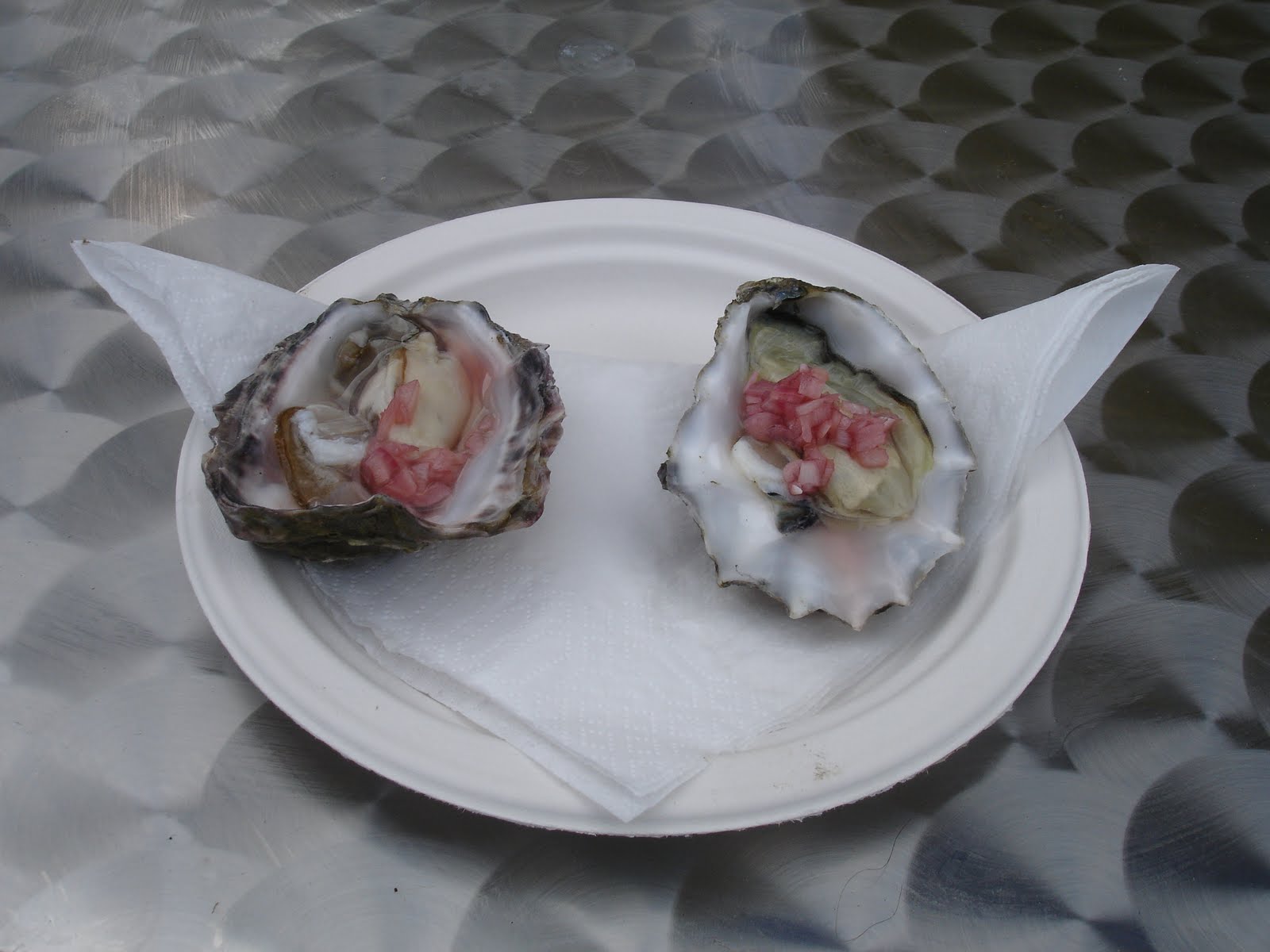
Jersey and West Mersea Oysters. They look grim but taste delish!
 My only criticism is that most were the type of street food you can get in markets such as Borough Market, Leather Lane, South Bank's now weekly Real Food Market, or Whitecross Street. These are great and very enjoyable, but didn't measure up to the promise of 'eat at favourite restaurants' as set out in the advert. Perhaps this will change over the weekend, as Saturday and Sunday are bound to have more participants from the food world, but was disappointing on the first day of the festival.

The demonstrations and tastings were a highlight of the day. Allan Pickett of Plateau (a very pleasant French restaurant in Canary Wharf with excellent views I can highly recommend) demonstrated his restaurant's newest Summer dishes; a simple but effective salad, sea bass (with demonstration on how to fillet this king of fish) and an achievable but appetising panna cotta. 
 
Allan Pickett does his stuff

The 'chef cam' means you can see exactly what Allan is doing
We were also privileged enough to attend wine tastings hosted by Charles Metcalfe. Charles is a well known wine critic (you may know him from his appearances on 'This Morning’, ‘Taste Today’, 'Great Food Live’ and ‘Sunday Lunch Live’. He is the co-chair of the International Wine Challenge (the world's biggest wine competition) as well as the co-author (with his knowledgeable, sweet and kind wife Kathryn) of a number of books. He sought to demystify as well as pass on his clear enthusiasm for the subject and his selections, particularly for the 'Food and Wine Matching', went beyond the dull textbook approach.

The array of foods and first glass of the tasting (Tio Pepe fino Sherry)

Charles Metcalfe effuses over how to pair wine with food (this time the Reisling)
Unexpected discovery of the day: Pink Port which is eminently drinkable as well as striking
The organisation of the event was generally good, although the system of registration for the Food Theatre, Drink Theatre and Chefs Theatre at the Registration Tent was, at the start of the day, time consuming. More staff to help and less time wasted would have been much appreciated. I understand completely the policy of making the food tastings, wine tastings and demonstrations strictly ticketed to prevent overcrowding, and in this respect the event was better thought out than Taste (first come first served), but the ticket distribution could have been speeded up. As the numbers will pick up for the second two days of the festival, this is an important point for the organisers to take on board.

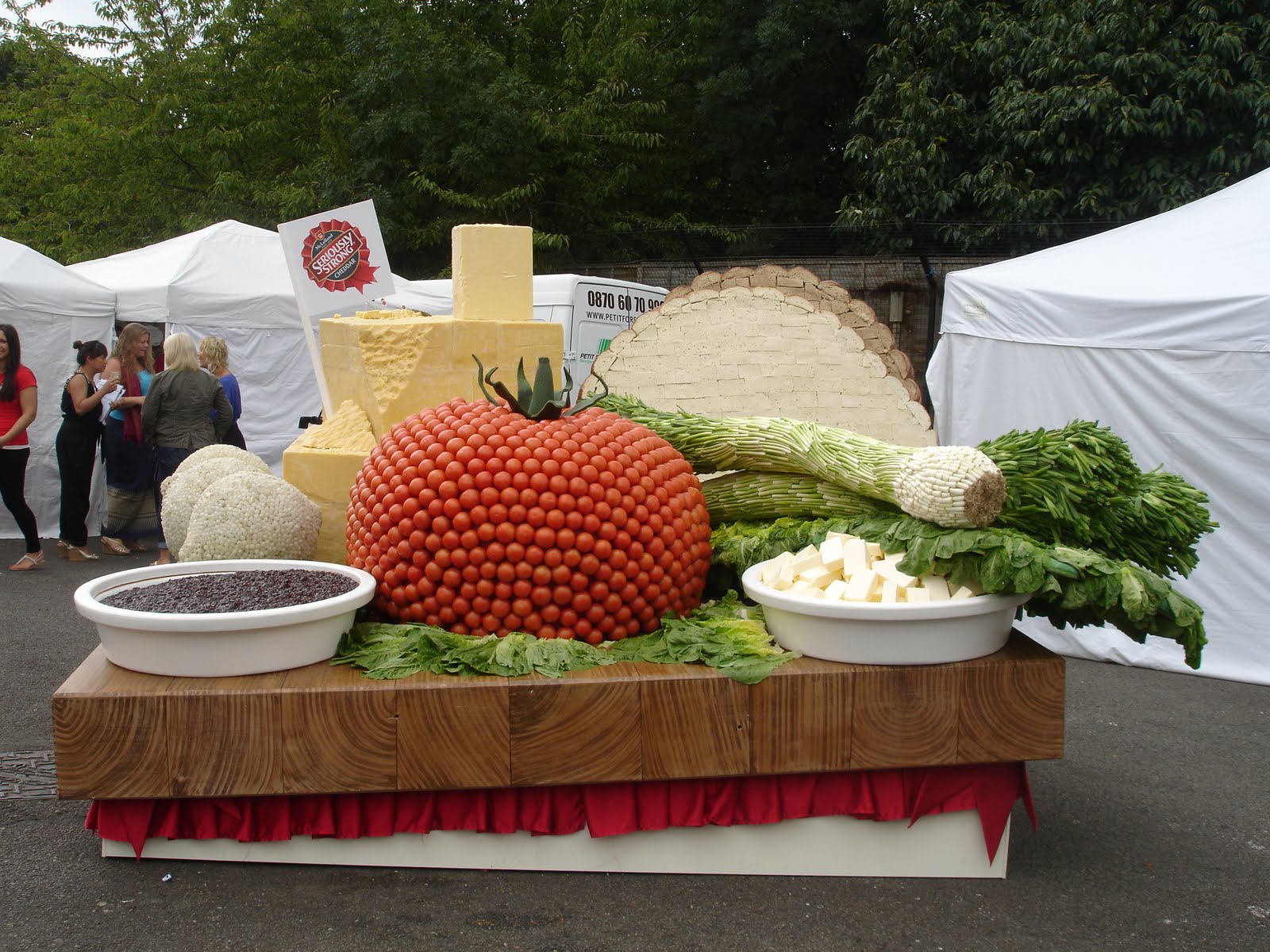
An unually large cheese board
I appreciated the fact that for this festival 'pictures of the queen' were the currency of the day. It was far more convenient, transparent and less of a 'must-spend-these-vouchers-only-valid-today' rush than the 'Crown' system used at Taste of London. I understand the reason Taste uses the Crown system; at such a packed event they don't need the hassle of having to handle and bank cash money, but the ability to pay in real money and take unspent home at the end of the day definitely ranks as a plus to me.

Seemingly random picture: A McKendrick's Gin rep shows off his skills on a Penny Farthing
 We had a good day out, all in all, and will most likely attend next year. You still have time to attend the final day tomorrow and if you do – bon appetit! The line up of chefs includes Anna Hansen and Giancarlo Caldesi and Charles Metcalfe will be back with at least 2 wine tastings. Hope you have enjoy it!

Wednesday, 27 July 2011

Snig's Street Food 101

When I go travelling, even for a short time, it is always rewarding to get the measure of a country's food heritage. As the late, great Keith Floyd once said (a quote which I think is an important truth of the human condition): 'To know a country, one must eat a country'. Now, obviously, he didn't mean REALLY eating a WHOLE COUNTRY; what he meant is their cuisine. If I interpreted him rightly, I think he was saying was to know the heart and soul of a people, their food is a pretty good indicator of their culture, history and shared experience. Now, people are not always themselves in a formal surrounding, so a posh restaurant won't be real reflection of the place. And in some countries, the indigenous simply can't afford the pleasure of eating in a restaurant. Hence, what better place for them to eat and be themselves than on the street? Street food, just like street photography (the capture of images of people unsuspectingly about their daily business), is often a telling statement about the place it is consumed in.

Many people tell me that they are scared of trying street food. If you live in London and all you have to go on is grubby hot dog stands and dodgy (but strangely alluring) late night kebab vans, I can see your concern. However, as you travel further afield, street food is often the best you can get, both as a culinary experience and as a cultural statement about the place you are visiting. I can vividly remember eating 'fish-bread' (tasty rolls of freshly grilled fish) in Istanbul (from the fish-bread men of Eminonu). In India I have partaken of delicious bhajis and pakoras. In Thailand, Malaysia, Cambodia and Singapore, I have tasted some of the best food I have ever eaten at street food stalls; and that compares with some of the best restaurants London has to offer.
Possibly the best Satay in the world, Jalan Petalling, Kuala Lumpur, Malaysia

So my advice when it comes to street food is GO FOR IT! But just mind a few basic rules.

Check the stall you are visiting out THOROUGHLY. There are a few things you should look out for. If you can see them prepare the food, then you will be able to see how clean everything is. Don't simply rely on cleanliness. You should also check how well stored the food is: cold items should be kept refrigerated or on ice, hot items should be kept hot. Raw and cooked foods should be stored separately. In Malaysia, I saw street stalls wash down their surfaces regularly with steaming hot water; this is a good sign, as the heated water will kill any germs. Food left sitting in the sun is best avoided, unless a hot dish kept piping hot (see below).

Any food cooked over 60°C will be safe. 60°C is a temperature which is the borderline of getting burnt; about the same temperature as hot candle wax. The temperature that germs and nasties are killed at. So if you cannot touch the pot the food is in without worrying about getting burnt, the food is hot enough. Anything piping hot (so hot there is steam coming off it) will be safe. Avoid any cooked food which is not piping hot. Curry which has been pre-cooked is fine as long as it is hot enough that germs cannot grow in it.
Hot enough for you? Frying gathia (spicy snack food) in Delhi, India
Wok food will generally not make you ill. In south east Asia the wok-cooked food is cooked over extremely fierce gas burners which gets the wok so hot it smokes. This is much hotter than any domestic UK gas burner and will ensure the food is raised to a temperature that no nasties can survive.

A queue is a good thing! I realise we, particularly in big cities, want instant gratification. Therefore we are much more likely to visit a stall with no queue. However, this is not the best logic where street food is concerned. Especially when you are not familiar with the place or quality of the food. A place frequented by locals is a place to be trusted. After all, if they got ill (and there is much likelihood of it happening where hygiene is poor), they won't return to the same place twice and will advise their friends accordingly. So if the place is deserted, on the one hand, they may just be unlucky and on the other, may just have poor standards.

Guide books like the Lonely Planet and Rough Guide used to warn you to shy completely away from all ice. These days that advice is a little extreme. And if you happen to be somewhere hot and humid, it is pretty punishing too! So my advice is, when checking out a stall, check out the ice situation. Mass produced ice cubes are much more likely to be safe and can be recognised by their factory consistent shape. These will tend to be made of purified water in factories. However, crushed ice could be made at home from local water and is best avoided.

A smaller choice is generally a safer choice. If a street food stalls sell few dishes, then the chances are they will have a quick turn over. If the turnover is fast then you can be quite sure they are using fresh ingredients and cooking fresh on the spot. The more dishes on offer, the greater the likelihood they have been left hanging around. If so, provided they are kept hot/cold (as appropriate – see above) you should be fine.

There is a theory that having had pro-biotic cultures before you travel can help. In other words, the 'friendly bacteria' in products like Actimel and Yakult can offer protection. It is possible, but I'm not testing this one out: rather you than me!

Don't be too paranoid! I've never gotten ill on my travels from street food. My most violent illnesses were from a restaurant which unbeknownst to me had its kitchen right next to the toilets (in Kerala) and a hippy bar with unclean glasses (in Malaysia). This accords with anecdotal evidence from many of my friends, many of whom were ill from meals from 4 and 5 star hotel restaurants. After all, their kitchens you cannot see, whilst a street stall's kitchen is transparently on display.
Openly open for business, the visible street kitchens of Sukhumvit Soi 38, Bangkok, Thailand
Beware the water. Free water will often be proferred with a meal, and is a kind gesture. However, if the water comes from the tap, it may make you unwell. On the other hand, it may be boiled or filtered water. Unless you can see the source, then do not drink it (although you may out of politeness not wish to refuse it). In Thailand, I saw hygienic chilled water filters where the customer could help themselves – a safe option, which may not always be available. Where you doubt the water, stick to bottled. Although if you saw 'Slumdog Millionaire', you will be aware that sometimes bottled water is not what it appears to be. Check you have an unopened bottle with seal attached. Many manufacturers are wise to the scam and make a cellophane cover over the seal which you have to turn to tear.

Think about ancient ethnic wisdom. The dishes which include turmeric, chili, ginger etc did so not just for flavour, but from a science which at the time was not capable of verification. It in fact turns out that ginger is anti-microbial and antiseptic which can kill germs such as salmonella. Chili stimulates the immune system and is thought to have anti-bacterial properties. Turmeric is both anti-bacterial and antiseptic (which is why it is rubbed onto cuts in India), keeping germs away from your food. Dishes including these ingredients are highly likely to be safer than those which do not.

If you get ill, please bear in mind the following:
  • Sometimes it is the sheer amount of spice that may trouble your stomach not the food.
  • It is dehydration which will do you harm more than the vomiting/diarrhoea. Keep drinking clean bottled/filtered water, checking your urine colour remains light. If orange or brown, you are severely dehydrated.
  • When unwell, eat very simply prepared foods. Nothing spicy, or too fatty.
  • Always pack some anti-diarrhoea medicine (such as loperamide) and fluid replacement salts (such as dioralyte). When illness strikes, you may feel too unwell or weak to make your way to a pharmacy.
  • You won't thank me for this, but please check your sick and your poop. Check there is no blood in either. Check that your poop doesn't become jelly-like or greenish in nature – this may be a sign of infection. Look for any other radical abnormalities and see a doctor or pharmacist when you notice them.
  • If your symptoms persist for more than 2-3 days, see a doctor or pharmacist, since you may have a bacterial infection and need antibiotics.

Saturday, 9 July 2011

Passionfruit Bellini

During the Summer, we all feel a little cheerier and are up for having some fun. As a result, you find yourself drinking more cocktails, with their fun, flashy glamour and light deceptive power. Sometimes you hardly notice that you are consuming alcohol, such are the highly enjoyable fruity flavours, an occupational hazard to be anticipated by anyone who has work the following morning!

Legend has it that the Bellini cocktail was invented in 1934 in Harry's Bar in Venice. It was named after 15th Century artist Giovanni Bellini, whose fame as an artist has now been eclipsed by the drink. The cocktail is made up of pureed peaches and Prosecco. The official recognised recipe calls for 2 parts Prosecco to 1 part peach puree, and ought to be served in a 'Collins' type glass.

In Venice, you can buy ready-mixed bottles of girly-pink Bellini which are light, fruity and easy to drink. Exactly what Him Indoors and I needed way back in July 2010 when we were trying to see as much as we could of that magical city in 33°C heat! Of course, Prosecco has grown steadily in popularity as our love for the fizzy stuff continues unabated.

Prosecco is produced in the 2 regions of Italy closest to Venice and its hot, sunny climate gives rise to a fruity, dry, gently sparking wine that I think is perfect for making cocktails with. Cava is often too aggressively fizzy, and champagne is both too dear and too strong tasting.

So I decided to experiment with fruity flavours suitable for making Bellinis. Raspberries were too tart to compliment the wine, which is just as well; my raspberry shrub is producing wonderful fruits right now which are perfect eaten as they are, rather than being juiced and used in drinks.

Kiwifruits produced a drinkable result, in a light alien green. It was something of a mission trying to get the juice out of them, and it took 2 whole kiwifruits to make 4 glasses of Bellini. Not an endeavour we shall repeat.

However, the runaway winner in our experiments was the passionfruit. Almost too tiddly to be eaten as a fruit, most of us only come across passionfruit via ready-made juice products.

We juiced them by scooping out the pulp from the passionfruit halves into the bowl of a clean tea strainer and pushing the juice through the mesh. 

Labour intensive, but worth it for the intense and pure flavour it gave to the Bellini.

We needed 3 passionfruits to make 4 standard champagne flute sized Bellinis. However, I will own up that Him Indoors and I did not share them with anyone else, choosing to sink the whole lot!

Wednesday, 6 July 2011

Spanish Cocido a la Snig (Spanish chickpea and meat stew)

Cocido is a dish I have enjoyed at lunchtime when visiting Spain. I have had it in Madrid and down in the south in Granada province, Andalucia. It is one of the really key Spanish dishes, cooked with love over several hours and served up to a hungry family for sustenance, comfort and satisfaction. It is a perfect example of how what is often regarded as 'peasant food' can be some of the tastiest dishes in the world.

The ingredients of Cocido can vary. I've had it with tripe and without it. But it always has pork, either in the form of pork belly, trotters or the bones. It also usually has Chorizo to impart its paprika and fats to the gravy of the dish. I did not realise this until I researched it further, that Cocido can feature meatballs, blood sausage (morcilla), potatoes and carrots.

The traditional way of serving Cocido is in 3 servings. The first being gravy and noodles (fideo pasta), the second being the vegetables and the 3rd being meat.

Personally, having had it served up in a single dish with a little pasta at the bottom and crusty bread to the side, I don't have the inclination to go for the 3 servings. Just the one with these accompaniments is divine!

Please note this recipe is based on my technique for making Cocido using an electric slow cooker. If you do not have one, I set out how to make it in the oven below, but have not tested the method.

I have heard of this dish being made in a Dutch pot/Dutch oven, but have not tried this method myself, not being in possession of such a pot. You will find the recipe, which is quite different from mine here:


Serves 4

Ingredients:
2 onions finely chopped
125g Chorizo finely sliced
65g Cubetti di Pancetta (or up to 80g if your packet is larger)
400g pork belly slices, cut into 1” chunks
8 chicken thighs/drumsticks or mix of both
100g chick peas, soaked overnight, then boiled for 15 minutes and drained
2 tomatoes finely chopped
3 cloves garlic, crushed or very finely chopped
4-5 sprigs fresh thyme
2 sprigs fresh rosemary
3 bay leaves
pinch of saffron soaked in half a mug of hot (not boiling) water
1 litre vegetable/chicken stock
3-4 tbsp olive oil
A couple of handfuls of fideo pasta or capelli corte or other very small pasta shape

Fry onion for 5 mins in the olive oil to start softening them. 

Then add the garlic and Chorizo, and fry, stirring frequently for another 5 minutes. The paprika will start seeping out of the Chorizo, colouring the oil reddy-orange; this is a good thing, so don't worry about this. It will add colour and flavour to the final dish. 

Remove to a plate, trying to keep the reddy-orange oil in the pan for the next stages.

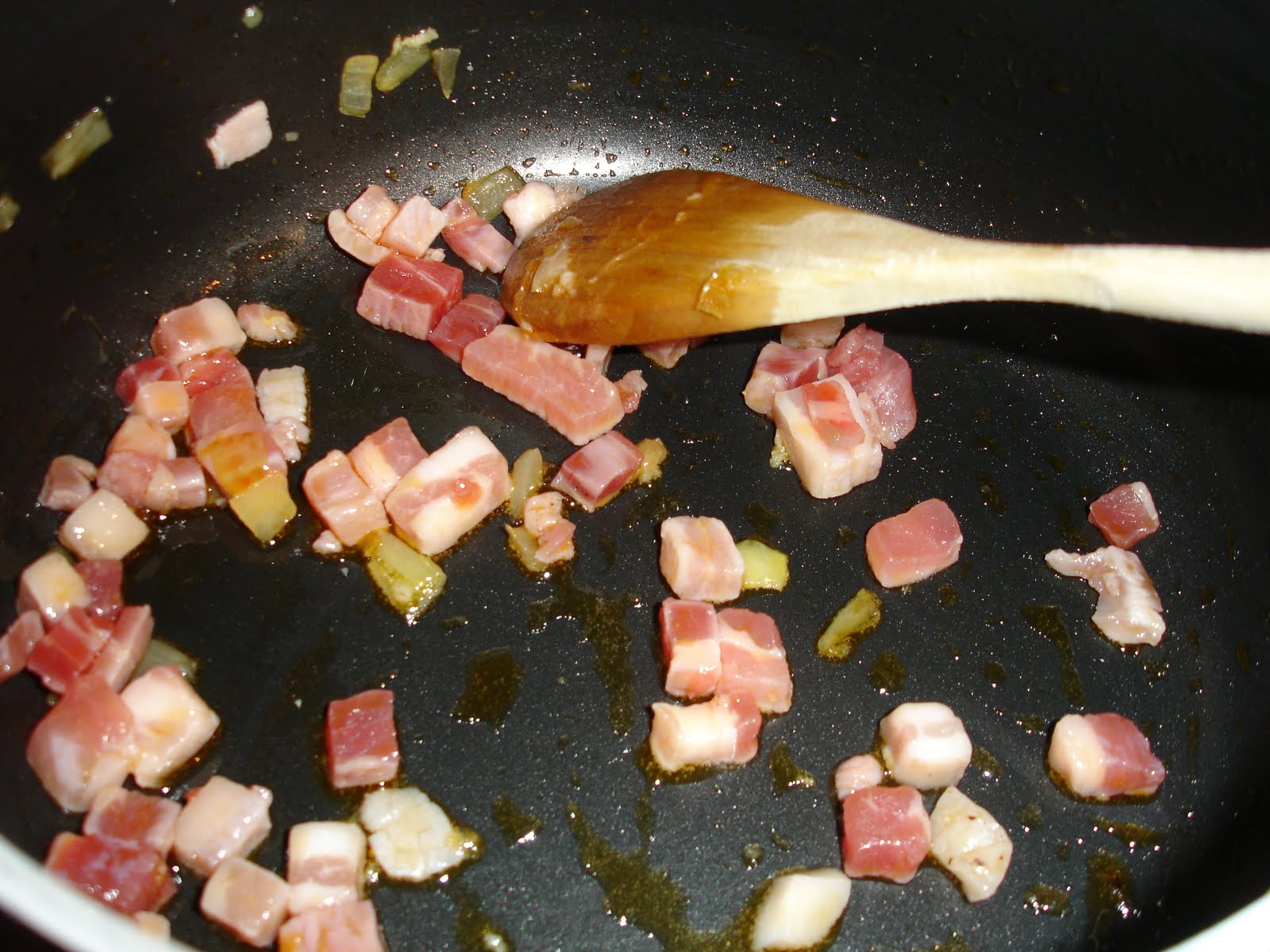
Next, fry the Pancetta until coloured, about 5 mins. Remove from the pan. Put with the other cooked ingredients.

By this time the pan will have a good flavour base, time to seal the chicken so the skin is beginning to go golden brown. Remove to a different plate.

Now return the onion, garlic, Pancetta and Chorizo to the pan. Add the tomatoes and herbs, and cook for 5 minutes – to get the flavours to combine and to start breaking down the tomatoes.

Add the saffron and hot water and mix, and then add the chicken and pork. Mix well, and add the chick peas. Pour the stock all over.

I cooked my Cocido in a slow cooker, meaning I gave it 8 hours on the slow cooker after the above steps were taken.


You may not have a slow cooker, or want the fuss. In which case you can always use a cast iron casserole dish for the above steps, and then put in the oven at perhaps 160 to 170°C for the remaining cooking. It will need at least 2 hours. Please note that raw soaked chick peas may not cook in this time, so you may want to used tinned instead.


Just when the Cocido is nearly ready, put a small pan of water on the hob for the pasta. As I said above, the authentic accompaniment is fideo pasta. However, I couldn't find this, so I used capelli corte (short cut angel hair pasta) which was a good substitute. Cook until al dente, then drain.

Put the pasta into the bottom of your serving bowl. 

Then serve the gravy with a good mix of the other ingredients and crusty bread on the side.


Friday, 1 July 2011

Butternut squash spread by Karin Struyk

I have received another recipe suggestion from a friend (the first was from my friend Raymond for Chicken Noodle Soup -  http://snigskitchen.blogspot.com/2011/05/my-first-recipe-suggestion-from-friend.html

Karin is an enthusiastic cook who enjoys experimenting with international flavours. I'm really pleased she has shared this recipe with me, and allowed me to post it here.

This spread is recommended for putting on bread/toast/biscuits as a snack or light lunch.

Rather than introduce the unadulterated heat of raw chilis or go to the trouble of roasting them especially, Karin uses the more mellowed earthy chili flavour of Indonesian sambal pastes. She has asked me to warn you that they are rather strong! If you are a vegetarian or vegan, please check the jar before buying, some contain fermented shrimp. You could add any hot chili sauce in its place if you are vegetarian/vegan.
For more information on sambal pastes, see: http://en.wikipedia.org/wiki/Sambal

If you roasted your squash with herbs (Karin recommends  thyme, rosemary or marjoram and black pepper), then you don't need to add any more. If you didn't add any herbs, then you can add half a teaspoon of chopped thyme and a teaspoon of chopped flat leaf parsley or coriander. Just make sure that you add a herb that does not require cooking, such as sage.

You will need:
Leftover  roasted butternut squash, cut into cubes (about ? -¼ – the size of a small tupperware container)
1a tablespoon of peanut butter
around 1 tablespoon of tahini (use double if you don't like peanut butter)
1 clove garlic, crushed
A teaspoon of Indonesian sambal (chili) paste (halve if you can’t take too much heat)
Black pepper
a drizzle of olive oil (amount will depend on how much the spread needs loosening)

Method: 
1. Start by whizzing the squash, and all the ingredients except for the oil in a food processor. Once mushy, check the texture.

2. Slowly drizzle the olive oil in, pulsing as you go, until you get a spreadable texture with a light sheen of olive oil.


Wednesday, 29 June 2011

Recipe Road Test: Atul Kochhar's Parsi Lamb Curry

As a child I was very lucky to have my mum's wonderful food. All Indian, with strong Bengali regional influences, my mum always cooked 'by feel' with no written recipe, no scales, no measuring spoons, just her instinctive knowledge of what would work right. Sadly, I didn't receive her special gift, even after trying to watch her many times in the kitchen. However, what I did receive was a taste for really good Indian food which in adult life has ended up being both a blessing and a curse. The sad part is that I find it very difficult to enjoy typical 'curry house' fare. Many of our typical high-street Tandoori restaurants make curries up out of large industrial jars of ready made sauce, leading to consistent results, but a terrible compromise on flavour. In my book, curry only works through the alchemy of cooking all the ingredients together, hence adding cubed meat to a ready made sauce is such an anathema to me.

Now, as I said earlier, I didn't obtain my mum's ability to cook by feel. This means I have to turn to the cook books. There are many excellent writers on the subject of Indian food; Mridula Baljekar, Anjum Anand, Vicky Bhogal, Reza Mohammed, Cyrus Todiwalla and the lady who started it all, Madhur Jaffrey. However, the man who is at the top of British Indian gastronomy currently is Atul Kochhar. Atul's “Benares” restaurant has shown that Indian food can fit the fine dining experience, being on of the very few Michelin starred restaurants serving Indian food in the UK. If you eat there, you will find real innovations based on the flavours, textures and cooking methods used in Indian food. Atul is pushing the boundaries, and achieving real success in doing so.

However, it isn't all about invention. If you want to be an artist, you start by learning the basic skills, then you copy from the great masters to refine your technique before developing your own style. Even the great Picasso studied and copied the works of the greats such as Velasquez. In Atul Kochhar's book “Simple Indian: The Fresh Tastes of India's New Cuisine”, Kochhar shows how he knows and understands completely the nuances and subtle differences between India's regional cuisines. In this book he shows his knowledge of the great dishes of India and his mastery over them, which allows him to experiment so successfully.

When it comes to Indian cooking, I am still serving my apprenticeship. So I attempted to make Kocchar's Parsi Lamb Curry with Straw Potatoes (Salli Ma Kharu Gosht) from Simple Indian (above). It turned out to be a wonderfully authentic north west Indian dish.
The recipe, taken from “Simple Indian: The Fresh Tastes of India's New Cuisine” by Atul Kochhar
First you must start by preparing the base of the curry sauce: onions, garlic & ginger paste, salt, chili powder, cumin, turmeric, cinnamon, dried red chili, cloves and green cardamom.
Curry sauce base: the usual suspects
Then you ensure you have your lamb in cubes, optional fresh chopped tomatoes (which I would recommend to be added to the dish as they lend the gravy flavour, colour and substance), and the deseeded green chilies, sliced in half.
Cubed boneless lamb (can use leg, which is preferred, or shoulder), fresh tomatoes and chilies
Once the ingredients have been prepared, you can then start cooking. This means you can pay proper attention to what you are doing. I can't chop tomatoes whilst trying to keep an eye on something else frying. If you can multi-task like that, go ahead!
Start by frying the whole spices in groundnut oil; dried chili, cloves, green cardamom and cinnamon.

Then add in the onions.
For a curry sauce with deep flavour, you need to fry the onions for a good 10 minutes. They need to start going brown at the edges. This isn't really done in European food, but that slight caramelisation (and slight burning) will impart flavour into the finished dish.

Once this has been achieved, a small amount of water and some ginger and garlic paste is added. They are added at this stage because they don't need as much cooking as the onions do, and you don't want them burning or they will spoil the dish. I don't keep ginger and garlic paste, so I simply grated the ginger and garlic freshly. If you cook curry often, it is an idea to make a very big lot of ginger and garlic paste in the food processor, freeze it into cubes (or tablespoon portions) so you are good to go whenever you want to cook up a curry.
After stirring for 2 minutes the ground spices; turmeric, salt, cumin and chili powder are added. Cook these out for a minute or so.


You will see from the picture above that the turmeric and spices have blended in with the sauce base ingredients and there is quite a bit of steam. This will lead to the curry sauce having a mellow and smooth spicy flavour.


The next step is adding the lamb and chopped tomatoes:

I found I had to stir the ingredients quite frequently to make sure the tomatoes were fully heated through and were starting to break down and to ensure the lamb was browned all over.
Adding the water for the gravy to form
I then started on the straw potato topping. This involved cutting up 2 small potatoes into chips a little thicker than matchsticks but not as thick as French fries. The potatoes were typical Summer type potatoes; a little waxy, so I was sceptical about how well they would fry and so took the decision to double-fry them. The first frying happened just after I added the water to the curry and left it to cook for 40 minutes and the second frying was just before it was time to serve up.

Allowing the excess oil to drain off:

Meanwhile the curry was cooking away.....
Becoming close to fully cooked....
Second frying of the straw potatoes:


And voila - Parsi Lamb Curry with straw potatoes! (I couldn't resist making up some dahl to have with it, though!)

This was an easy to follow recipe with nothing to throw the cook off track. If everything is prepared in advance, all you have to do is follow the simple cooking instructions. Atul Kochhar's description of the method is direct and to the point. Whilst the straw potatoes added a new texture and some pizzazz to the look of the dish, strictly speaking, this would have been a very tasty lamb curry without them. The deseeded chili sliced lengthways brought a heat to the dish which was not overdone and allowed the flavour of the lamb and North Indian spicing to shine. This was a very nice curry that I will be making again.