Showing posts with label eating out. Show all posts

Wednesday, 27 July 2011

Snig's Street Food 101

When I go travelling, even for a short time, it is always rewarding to get the measure of a country's food heritage. As the late, great Keith Floyd once said (a quote which I think is an important truth of the human condition): 'To know a country, one must eat a country'. Now, obviously, he didn't mean REALLY eating a WHOLE COUNTRY; what he meant is their cuisine. If I interpreted him rightly, I think he was saying was to know the heart and soul of a people, their food is a pretty good indicator of their culture, history and shared experience. Now, people are not always themselves in a formal surrounding, so a posh restaurant won't be real reflection of the place. And in some countries, the indigenous simply can't afford the pleasure of eating in a restaurant. Hence, what better place for them to eat and be themselves than on the street? Street food, just like street photography (the capture of images of people unsuspectingly about their daily business), is often a telling statement about the place it is consumed in.

Many people tell me that they are scared of trying street food. If you live in London and all you have to go on is grubby hot dog stands and dodgy (but strangely alluring) late night kebab vans, I can see your concern. However, as you travel further afield, street food is often the best you can get, both as a culinary experience and as a cultural statement about the place you are visiting. I can vividly remember eating 'fish-bread' (tasty rolls of freshly grilled fish) in Istanbul (from the fish-bread men of Eminonu). In India I have partaken of delicious bhajis and pakoras. In Thailand, Malaysia, Cambodia and Singapore, I have tasted some of the best food I have ever eaten at street food stalls; and that compares with some of the best restaurants London has to offer.
Possibly the best Satay in the world, Jalan Petalling, Kuala Lumpur, Malaysia

So my advice when it comes to street food is GO FOR IT! But just mind a few basic rules.

Check the stall you are visiting out THOROUGHLY. There are a few things you should look out for. If you can see them prepare the food, then you will be able to see how clean everything is. Don't simply rely on cleanliness. You should also check how well stored the food is: cold items should be kept refrigerated or on ice, hot items should be kept hot. Raw and cooked foods should be stored separately. In Malaysia, I saw street stalls wash down their surfaces regularly with steaming hot water; this is a good sign, as the heated water will kill any germs. Food left sitting in the sun is best avoided, unless a hot dish kept piping hot (see below).

Any food cooked over 60°C will be safe. 60°C is a temperature which is the borderline of getting burnt; about the same temperature as hot candle wax. The temperature that germs and nasties are killed at. So if you cannot touch the pot the food is in without worrying about getting burnt, the food is hot enough. Anything piping hot (so hot there is steam coming off it) will be safe. Avoid any cooked food which is not piping hot. Curry which has been pre-cooked is fine as long as it is hot enough that germs cannot grow in it.
Hot enough for you? Frying gathia (spicy snack food) in Delhi, India
Wok food will generally not make you ill. In south east Asia the wok-cooked food is cooked over extremely fierce gas burners which gets the wok so hot it smokes. This is much hotter than any domestic UK gas burner and will ensure the food is raised to a temperature that no nasties can survive.

A queue is a good thing! I realise we, particularly in big cities, want instant gratification. Therefore we are much more likely to visit a stall with no queue. However, this is not the best logic where street food is concerned. Especially when you are not familiar with the place or quality of the food. A place frequented by locals is a place to be trusted. After all, if they got ill (and there is much likelihood of it happening where hygiene is poor), they won't return to the same place twice and will advise their friends accordingly. So if the place is deserted, on the one hand, they may just be unlucky and on the other, may just have poor standards.

Guide books like the Lonely Planet and Rough Guide used to warn you to shy completely away from all ice. These days that advice is a little extreme. And if you happen to be somewhere hot and humid, it is pretty punishing too! So my advice is, when checking out a stall, check out the ice situation. Mass produced ice cubes are much more likely to be safe and can be recognised by their factory consistent shape. These will tend to be made of purified water in factories. However, crushed ice could be made at home from local water and is best avoided.

A smaller choice is generally a safer choice. If a street food stalls sell few dishes, then the chances are they will have a quick turn over. If the turnover is fast then you can be quite sure they are using fresh ingredients and cooking fresh on the spot. The more dishes on offer, the greater the likelihood they have been left hanging around. If so, provided they are kept hot/cold (as appropriate – see above) you should be fine.

There is a theory that having had pro-biotic cultures before you travel can help. In other words, the 'friendly bacteria' in products like Actimel and Yakult can offer protection. It is possible, but I'm not testing this one out: rather you than me!

Don't be too paranoid! I've never gotten ill on my travels from street food. My most violent illnesses were from a restaurant which unbeknownst to me had its kitchen right next to the toilets (in Kerala) and a hippy bar with unclean glasses (in Malaysia). This accords with anecdotal evidence from many of my friends, many of whom were ill from meals from 4 and 5 star hotel restaurants. After all, their kitchens you cannot see, whilst a street stall's kitchen is transparently on display.
Openly open for business, the visible street kitchens of Sukhumvit Soi 38, Bangkok, Thailand
Beware the water. Free water will often be proferred with a meal, and is a kind gesture. However, if the water comes from the tap, it may make you unwell. On the other hand, it may be boiled or filtered water. Unless you can see the source, then do not drink it (although you may out of politeness not wish to refuse it). In Thailand, I saw hygienic chilled water filters where the customer could help themselves – a safe option, which may not always be available. Where you doubt the water, stick to bottled. Although if you saw 'Slumdog Millionaire', you will be aware that sometimes bottled water is not what it appears to be. Check you have an unopened bottle with seal attached. Many manufacturers are wise to the scam and make a cellophane cover over the seal which you have to turn to tear.

Think about ancient ethnic wisdom. The dishes which include turmeric, chili, ginger etc did so not just for flavour, but from a science which at the time was not capable of verification. It in fact turns out that ginger is anti-microbial and antiseptic which can kill germs such as salmonella. Chili stimulates the immune system and is thought to have anti-bacterial properties. Turmeric is both anti-bacterial and antiseptic (which is why it is rubbed onto cuts in India), keeping germs away from your food. Dishes including these ingredients are highly likely to be safer than those which do not.

If you get ill, please bear in mind the following:
  • Sometimes it is the sheer amount of spice that may trouble your stomach not the food.
  • It is dehydration which will do you harm more than the vomiting/diarrhoea. Keep drinking clean bottled/filtered water, checking your urine colour remains light. If orange or brown, you are severely dehydrated.
  • When unwell, eat very simply prepared foods. Nothing spicy, or too fatty.
  • Always pack some anti-diarrhoea medicine (such as loperamide) and fluid replacement salts (such as dioralyte). When illness strikes, you may feel too unwell or weak to make your way to a pharmacy.
  • You won't thank me for this, but please check your sick and your poop. Check there is no blood in either. Check that your poop doesn't become jelly-like or greenish in nature – this may be a sign of infection. Look for any other radical abnormalities and see a doctor or pharmacist when you notice them.
  • If your symptoms persist for more than 2-3 days, see a doctor or pharmacist, since you may have a bacterial infection and need antibiotics.

Monday, 20 June 2011

Taste of London 2011

I went to the very first Taste of London festival. Back then, the event was held in the far smaller environs of Somerset House, which lent grandeur and a lovely background, but insufficient space. Since then it has moved, and grown immensely. A large section of Regent's Park was given over to what Michel Roux Jr describes as 'food heaven'. This year 44 restaurants participated, along with many bars. Some are real heavyweights in the food world; Roux himself was represented by Le Gavroche and Roux at the Landau, also present were Gauthier, Petrus, Scott's and many more. It wasn't all about the top restaurants, though. Many smaller, up and coming and non-European restaurants participated.

My husband (aka Him Indoors) and I visited the festival on its final day. We bought our tickets on the 'premium' deal, costing £38 each with £20 in “crowns” (the currency for the festival) included. This seemed a much better deal than the £22 standard entry with seemingly no crowns at all (which went up to £26 each on the door). The online tickets we printed off in advance got us into the festival with a minimum of fuss, and we realised when we saw the queue for the on-the-door tickets, had saved us a lot of time!

Regent's Park was decidedly wet under foot on Sunday after all the rain we've been having in London. As a result, wellies really were the order of the day! Some areas of the site got a little boggy, reminding everyone that Glastonbury is on its way. We had a couple of showers during the course of the afternoon, but everyone was in the mood to make the best of it. People huddled together until the showers passed, before moving on to the next delight.
Snigdha at the Pink Fork; a true Taste landmark!
The organisers have done a great job of ensuring punters can get the most out of their day. The festival booklet included a map of the site, timetables for the cookery demonstrations, book signings and wine tastings. Most helpful of all, however, was the menu card; a full list of all the dishes on offer, with their cost in crowns. Much easier than wandering around trying to read the menu boards, particularly at some of the busier restaurant stalls.

Having recently seen the pictures of the RMT union boss Bob Crow dining at Scott's, we decided to check them out. Prohibitively expensive for a real sit down lunch for me and Him Indoors, we figured this was a great opportunity to see what all the fuss was about. After all, we thought, if it is good enough for Mr Crow, it is good enough for us! I had the octopus carpaccio, Him Indoors the shrimp and scallop burger. Both were delicious. The burger was cooked to perfection with a soft, yielding texture. The carpaccio with slow roasted tomatoes was seafood heaven on a little wooden dish.

That small treat started us off on a day of great discoveries....

ORA's take on contemporary Thai cuisine was a disappointment to me. Their Grilled tuna dish (Pla Tuna Song Kreung) was overcooked despite being served cold. If served freshly cooked from a mobile kitchen, a little overcooking could be overlooked, but was unforgivable for something pre-prepared. A terrible shame given the lovely flavours of lemongrass, tamarind and fresh herbs it was served with.

One memorable treat was Richard Corrigan's lovely traditional fish and chips. Corrigan's Mayfair did us proud with wonderful double (or was it triple?) cooked chips, fluffily battered highly fresh fish and a homemade tartare sauce which brought the dish together perfectly. Possibly even better than the fish and chips I had at Rick Stein's Padstow chippy, and with less of a journey to get there!
Delectable fish and chips by none other than Richard Corrigan
Snigdha gets to meet the man himself; Richard Corrigan

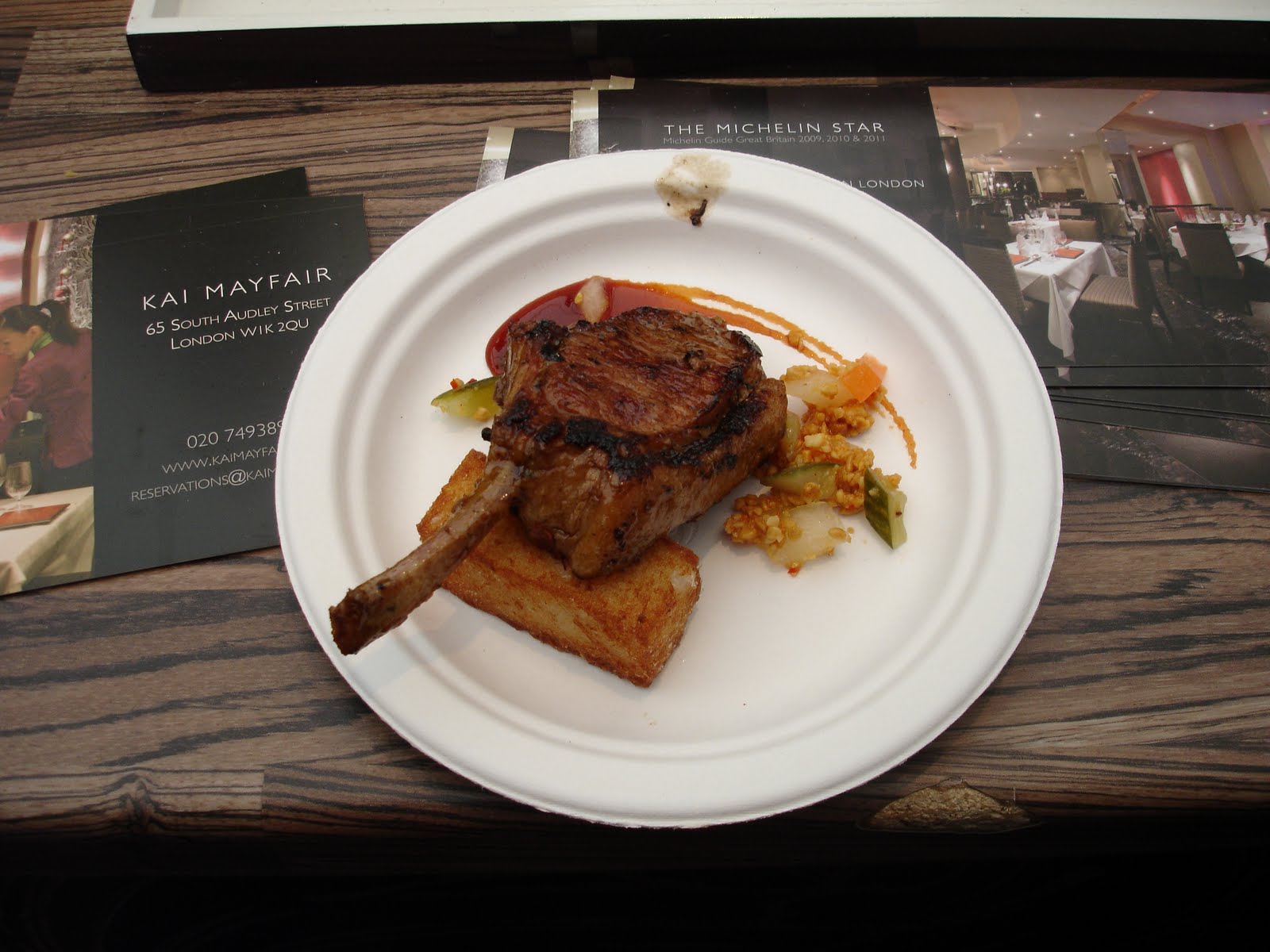
Kai Mayfair's pan-asian contemporary cuisine was good, if not brilliant. Their barbequed soy and honey marinated lamb was cooked just right, with appealing flavours. Maybe I am being a little hard on it, but I can't get over my disappointment that the 5 hour cooked belly of pork sold out!


Thanks to the Executive Chef of the Ritz, who let me try truffle for the first time. I can see now why it is used so sparingly in food. Not due to its price, but its intense nuttiness.
Guess the price of this truffle; answers on a postcard!

Indian food was well represented by Tamarind, the Cinnamon Club, Cafe Spice Namaste and of course, the wonderful Benares. Benares is perhaps the most interesting of all of them; a place where Indian food is being given the fine dining feel and elevated to an art form. No-one is doing the sub-continent's food greater justice than Atul Kochhar, so you would hardly believe my surprise when I bought my Grilled fennel infused lamb chop with mint chutney, for the man himself to come out to serve us all!
Snigdha meets the amazing Atul Kochhar

This is, to my mind, one of the real indicators of how important an event in the foodie's year that Taste of London has become. Many top chefs and 'celebrity' chefs had set up temporary restaurants at Taste, and even though their reputations would have sold the food by itself, several made the effort of visiting and meeting the public. Taste of London is a great way to familiarise yourself with the styles and food of restaurants you might not want to take the chance on for a full meal and for the restauranteurs, it is an opportunity to build a customer (and fan) base.
Snigdha meets Pearl's Jun Tanaka, promoting new project Street Kitchen

We participated in 2 wine tastings. The first was Waitrose's selection of “Barbeque Treats”; a selection picked with suitability for Summer Barbeques in mind. Fingers crossed we will get the weather to try this out for real! They were a mixed bunch, a Le Paradis 2009 Chinon and Brown Brothers Moscato Rosa 2009 which were an uninspiring mild red and syrupy 'party juice' respectively. The Waitrose Reserve Shiraz St Hallett 2009 had a strong deep taste with heavy tannins; a candidate for beef bourginon, methinks (you serve it with the wine you cooked it in). The Rabbit Row Sauvignon Blanc 2010 was an interesting discovery; made by the same producer as Vina Maria, this was a smooth and drinkable Marlborough Sauv Blanc. Definitely one for the trolley! Despite its inclusion as a BBQ wine, the Domane Wachau Gruner Veltliner “Terraces” seemed to us to be an unoaked wine which would go unusually well with spicy food. Matching wine with Indian and Thai foods is often difficult, but this off dry wine was smooth with fruity aromas. One for my next curry cook-off!

The second tasting was a specialist tasting for Italian dessert wines. It was organised by Grossi Wines, a specialist importer who only buy from small producers and insist on high standards in production such as no mechanised harvesting. Our guide to the wines was the lovely, highly knowledgeable and deeply enthusisastic Gemma.
Gemma from Grossi Wines, with Snigdha

We tried a 2005 Michi Vin Santo, a rich wine with warm raisin tones and hints of burnt sugar, a 2007 Silver Medal winning Verlit (our favourite) made by Marco Checchine, a Mazzi 2005 Le Calcarole (reciato della Valpolicella Classico) full of blackcurrants and jam and finally a Pometti, the 'wild card' of the bunch; a liquer of 20% strength made from wine blended with pomegranate juice before being fortified. I could almost feel myself transported to a hillside Italian restaurant dipping crunchy biscuits like cantucci into my glass having consumed a delicious meal beforehand! And all included in the price of the ticket!
Can you tell which was our favourite?

All of which brings me back to the issue of cost. One crown costs 50p, with the majority of exhibitors not taking any cash payment whatsoever. Generally the dishes were 8, 10 or 12 crowns, unless you were going for something particularly grand, such as Skylon's lobster at 20 crowns or Gary Rhodes' Jaffa Cake Pudding at an amazing 30 crowns! Some have complained about the overall cost of the Taste of London event. I wouldn't say it is a cheap day out. On top of our £76 ticket costs, we clocked up another £20 in crowns, making it almost a hundred pound day out. However, we had some amazing food from restaurants we can only dream of eating in (Scott's needs to be booked at least 2 months in advance). We also were able to mix and match between dishes made by some of the UK's finest chefs, which you can't do anywhere else. And given the amount we had to imbibe, we certainly got our money's worth. By all means, grumble about the cost, but a meal for 2 in London would easily cost £100. We will be back next year, for sure!

Friday, 13 May 2011

The Restaurant Rules

Originally posted by Snigdha yesterday. Lost by 'Blogger' today, hence the re-post. Not happy!

I've just come back from Thailand. I fear that I will be posting a number of articles both inspired and obsessed by my travels around that beautiful, inspired and amazing country. What I want to deal with in this post, however, is how do you choose a place to eat when travelling?

At home, it's easy. Ask your friends and family for recommendations. Log in to toptable and look at reviews. Information is reliable and readily available. Job done, as Obama would say.

But what do you do when abroad? Once upon a time, I'd buy the latest edition of the Rough Guide or Lonely Planet and I'd follow their recommendations. I must say, it often worked for me. There were the wonderfully memorable Indonesian restaurants (at both the high and low end of the spectrum) in Amsterdam that I visited with my husband and best mate Chris that stand out as magical moments of our trip to that fair city. The 'tchendol', a strange, sweet yet tart tamarindy drink we enjoyed is etched on our collective memories forevermore. In Delhi I would never have found the basic but brilliant Punjabi restaurant with huge vats of steaming curry, nor the tiny, rustic but packed Paratha place in 'Paratha Wale Gale' just off Chandni Chowk. So guidebooks have their uses.

Picture: Paratha at Paratha Wale Gale, Delhi, India.

However, a book is only as reliable as often as it is updated and I clearly remember trying to find a restaurant in Phuket 11 years ago which was recommended by Lonely Planet and was a less than happy experience.... Picture the scene: at 7:30 we decide to make our way to said restaurant, not quite realising how far away from the hotel it actually is.... in the meantime gets dark. Then it starts to rain. Torrentially. But we have no umbrella. Then we come to a wooden slatted foot bridge. With steps missing. We cross, but it's all a bit too 'Indiana Jones' for my liking. After much stress and worry about imminent loss of life, we come to the exact address stated in the book after a further half an hour of searching. No restaurant. What is going on? We got back to our hotel and decide to call said restaurant – they closed a year ago! A scary experience where not once I thought that both myself and my tiny LED torch would fall steeply into the river below!

And that is not the only occupational hazard. Chefs leave, service declines. In fact, it's a pretty good rule of thumb that as soon as a restaurant gets recommended by a mainstream guide book that the staff will rest on their laurels and the quality will decline. This happened particularly with 2 restaurants in Jaipur who ought to know better (and I will not name!).

So how do you work out where to eat when travelling further afield? I have two rules, one which comes from my own experience and the other from a lovely man I met in pottery class once called John (AKA Pottery John). Thanks, John – you are a star!
  1. The locals test
Work out who the indigenous people are wherever you are. Where they eat will be pretty damn good. After all, whether lunch or dinner, they wouldn't keep coming back to some tourist place with poor food and bad service day after day. So, regardless of your snobbery, if you are in Venice and you see some gondoliers or boat builders eating in a trattoria – chances are it's pretty good. Similarly, if you are in Chinatown in London and you see people who are Chinese eating there, you have similarly struck gold. Don't fret about the surroundings, in fact ignore them if they are modest or even scruffy – if the indigenous eat there you aren't going to get a bad meal.

Picture: The Locals Test in action: Sabung-Gha, Chiang Rai, Thailand
  1. Don't worried about the food taking time to arrive
We have all been spoiled by places which get food to us within minutes of taking our order. It has lulled us into the philosophy of instant gratification, which if we are honest, does not and should not exist in real life. Posh restaurants have all sorts of 'cheats' to ensure you are not left waiting too long for your food; ingredients prepared and piled high in large plastic containers, risottos part cooked and just waiting to be finished off as they are ordered (see Marco Pierre White's book Wild Food From Land and Sea to find how they manage this). But really authentic food, if prepared with the love and care that you wish for, will take time. Sometimes that means from 15 mins to 30 mins. Just make sure you go out before you get to that starving hungry stage and enjoy the results. And don’t complain to the staff that you’ve been waiting for ages, or they’ll conclude you favour microwave meals that you just prick and ping.

  1. The tablecloth rule (with thanks to Pottery John)
To cater for Western European tourists, restaurants feel they must give that 'cultured' presentation; posh cutlery, candles and most importantly, linen tablecloths. These can only be used the once and then have to be sent to be laundered. The extra cost of their being laundered is then passed back to the customer, of course. This is something the indigenous local neither values nor wishes to pay for – they seek only the quality and authenticity of the food. So if you find a restaurant with posh linen, chances are it is only there to entice tourists into eating in their establishment. Therefore, no tablecloth (or a wipe clean plastic tablecloth) will usually be a sign of good, honest unpretentious food. Of course this rule doesn’t apply to a fine dining restaurant – but as with all rules there are always exceptions.

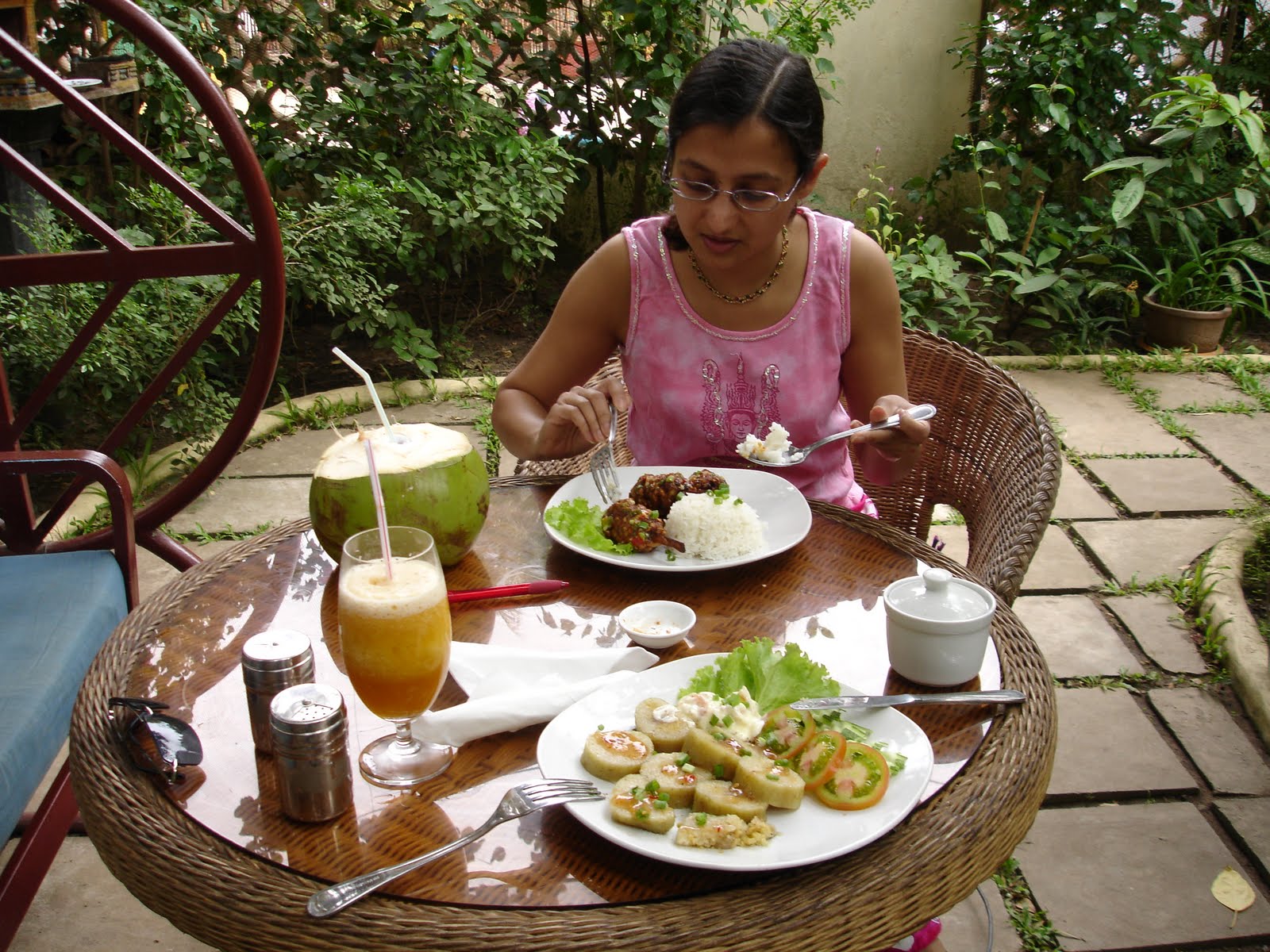
Picture: The tablecloth rule in action, Cambodia.


These rules have stood us in very good stead in places as diverse as Italy, India, Cambodia, Thailand and France (among others). Maybe they will work for you. What are your rules? Do they work? Let me know....