Showing posts with label white wine. Show all posts

Monday, 3 April 2017

Cremant Sparkling Wine tasting 2017


Last year, I wrote about how Cremant is the great “undiscovered bubbly”. We know Champagne, Cava and most recently have gone potty for Prosecco.

Cremant is a French fizzy wine. The production process has to follow strict guidelines; grapes must be hand gathered, no machines; double fermentation (the second being in the bottle) and only 8 regions of France are allowed to call their bubbles Cremant. The name hints at one of the essential qualities of the wine; a creamy texture across the mouth.

I was invited to Business France’s Cremant tasting for 2017 at Edel Assanti Gallery in London’s Soho where 12 producers were ready to show off their best bubblies. Chilled magnums of other notable Cremants were also waiting to shared. To top off this thoroughly French treat, savoury and sweet Macarons were available on tap!


I got started with Domaine Schwach (pronounced “shwah”). The name gives you a clue of their location, in Alsace, near the German border. I was guided around the Schwach wines by Eric Zweibel, a Dorset based expert (and award winning) Sommelier, originally from Alsace. I tried the Blanc de Blanc (made solely of pale/white grapes), a wine with hints of lemon aromas and sherbetty fizz. It has good complexity, as a result of the initial 12 month fermentation in lees. One to drink on its own for a celebration, or as an aperitif. Alsace’s dishes often feature smoked hams and smoked cheese, Eric advised this Cremant D’Alsace Blanc de Blancs would go well with these traditional foods. 


Next was a Blanc de Noirs, made from black/dark grapes, namely Pinot Noir (the same grape as Champagne). I detected a light pinky tinge in the colour, and the flavours were very different from the Blanc de Blancs; this was strong, structured and more “masculine” as described by Eric. Finally I tried the Cremant d’Alsace Chardonnay, a completely different wine, made by adding 4 grammes of sugar for the second in-bottle fermentation. The colour of this wine is incredibly pale, but the flavours exude pure elegance. Clean, rich, creamy on the palate, this 100% chardonnay sparkling wine is unique. Domaine Schwach is a modest 19 hectare winery, run by the same quality obsessed family for three generations, their wines are far more creamy in texture than the other, crisper Cremants in the tasting.

Next was Domaine Moutard-Diligent, a North Burgundy winemaker more famous for their Chablis and Irancy. A winemaker originally founded in 1645 in the Champagne region, and having made Champagne for three generations, Moutard-Diligent bought a vineyard in Burgundy in 2004. In 2015, they decided to use their long held expertise in sparkling to make Cremant de Bourgogne. I tried the Cremant de Bourgogne Les Vignolles, a Brut (dry sparkling wine) made of 50% Pinot Noir (the Champagne grape) and 50% Chardonnay. A barely-there pale colour, tiny bubbles, delicate slow fizzing; it has the look in the glass of a fine sparking wine. A crisp and extremely dry flavour tempered with real elegance makes this bubbles suited for seafood (think a seafood platter in the Summer sunshine), or sushi. 


Cremant de Jura is the new “up-and-coming” Cremant Appellation. The vast majority of the Jura Cremants are white. 100% Chardonnay varieties exist. If a blend is used, it must be made of a minimum of 70% Chardonnay, Pinot Noir and Trousseau grapes. The other grapes allowed (to help provide balance and flavour) are Poulsard and Savagnin. The wine must be aged for a minimum of one year. I tried the 100% Chardonnay Marcel Cabelier 2012 Cremant de Jura. This wine was unique for its 20-24 month aging in lees, before the second in-bottle fermentation. Beautifully pale, this wine had delicate, balanced dry flavours with good minerality. 


Another wine producer which caught my attention was “La Compagnie de Burgondie”, a fascinating combination of three specialist makers; Caves Bailly-Lapierre (Cremants), Vignerons de Buxy (Cote Chalonnaise and Premier Cru) and Alliance Vignerons Bourgogne Beaujolais (Beaujolais). Bailly-Lapierre, as Pierre Jerome Beretti explained, is famous for being the producer who created and registered the Appellation of Cremant de Bourgogne in 1975. The Cremant de Bourgogne Brut Reserve is a four grape blend of Chardonnay, Pinot Noir, Aligote and Gamay. With an intriguing scent of toast and a touch of dead leaf (sounds terrible, but think of Autumn in the air), it has frothy little bubbles, and good balanced dryness. It is fresh as the amount of added sugar is extremely modest. The finish is short, but pleasant. A bubbly for an aperitif or for enjoying with sophisticated starters, it should sell for around £14 in the UK, making it affordable luxury. 


Pierre let me try the Cremant de Bourgogne Chardonnay, a new product not yet on the UK market. Made from 100% Chardonnay, it as fresh, clean white aromas, with subtlety. Hints of pear are present. Balanced acidity on the tongue with elegant fruit. A long and satisfying finish makes this a wine worth experiencing with all of your senses. This is a wine which would be excellent for Summer celebrations. 


Cremant de Limoux is the sparkling wine made close to Limoux in the Languedoc region, given Appellation status in 1990. 


The Terroir La Baume Cremant de Limoux 2016 is a Gold Medal winning wine, made from a Chardonnay, Pinot Noir and Chenin Blanc grapes. The fine bubbles give character, and the crisp flavour, slightly appley aroma and meadow freshness make it highly suitable for fish and seafood. A wine to watch out for, being a worthy award winner. 

Cremant de Loire is made using Chenin Blanc grapes in the Anjou, Saumur and Touraine areas. Nathalie Safran introduced me to the Cremant de Loire of Caves de Grenelle, the only specialist sparkling wine maker in Saumur. 


Established in 1859, this is a wine house which has been family run since its inception. The first wine I tried was the “pretty in pink” rose, Cuvee Si Irresistable; a Mousseux Brut, rather than a Cremant. This wine, made of Grolleux grapes is so different because it has a very short fermentation, hence the reason it cannot be called a Cremant. It is flowery, strongly aromatic, with a little sugar in the aroma (I swear I am able to smell sugar in other people’s tea). The flavour is fresh and light, making is great for sunny days and desserts. But Nathalie warned me not to be unimaginative; the wine, she says, will surprise you with its suitability for food, citing oysters as being particularly well matched. 

The second wine was the Cuvee 3/7.7.4, the Caves de Grenelle, also called “La Magie du Noir” (the “Magic” of black). Devised to be the ultimate expression of what can be done with Pinot Noir, Cabernet Franc and Pinot d’Aunis, it has a pronounced colour, minerality in the flavour and a strange, pure, almost medicinal aroma. It is a “statement” wine of creamy delicacy, and should be  bought now and saved in a cellar for a few months.

Snigdha visited the 2017 Cremant tasting organised by Business France as their guest. This review represents my honest opinions. Snigdha has received no incentive, financial or otherwise for posting this review.

Wednesday, 22 March 2017

Grand Cercle de Bordeaux En Primeur 2016 vintage


Bordeaux winemakers, some of the greatest in the world, have united to make a community, Le Grand Cercle de Vins de Bordeaux to help ensure quality, spread the best methods and techniques, and help find wine fans and customers around the world. I was invited to their En Primeur 2016 tasting show to taste last season’s wine, harvested over Autumn/Winter 2016, which is coming onto the market to canny people willing to buy now and get a bargain. Later, when some of these wines have aged, their price will seriously increase and perhaps even multiply.


At London’s Le Meridien Hotel in Piccadilly, the dedicated winemakers and estate owners assembled for this special tasting, designed to give buyers and reviewers a sneaky peek at what will be coming from Bordeaux over the coming months and years. 


The first wine I sampled was the Chateau de Cerons sweet white wine. Based in the same region as Graves (Rive Gauche of Bordeaux), Cerons was, as I was informed by owner Caroline Perromat “a miracle”. She explained that Cerons is a “tiny appellation” of 21 hectares only. The same Semillon grapes are used as the more well-known Graves AOC wine, with the deciding factor being the amount of botrytis on the grapes. 80% Semillon, 18% Sauvignon, 2% Muscadelle is the makeup of this unique wine. The vineyard is only 6km from Sauternes, but the result is a botyritis late harvest wine which is very different from its illustrious famous cousin.


I found a good balance of acidity, a delicate aroma, without over sugaring. Touches of saffron are detectable with slightly mild sweetness and the merest hint of orange. Caroline explained that it is always a challenge to balance the texture with freshness of the fruit, but I would say they have met that challenge with panache. The Chateau de Cerons sweet white wine is made by an extraordinary    natural process, and as a result, they do not produce a wine each year and only 3000 bottles are produced if done at all. Quality and condition of the grapes is the key factor. Quality control and care appear to be the watchwords, as the wine is generally kept for 10 years of aging before being marketed; the 2008 is only now on sale. A gorgeous wine for an indulgent Foie Gras starter or with dessert.

 
Chateau Fombrage was the producer of my next wine, another white wine, from the same estate as a renowned Saint-Emilion Grand Cru Classe. However, despite being produced in Saint Emilion, it cannot be granted AOC status because the region famous for its red wines. The 2016 En Primeur wine is made up of 60% Sauvignon blanc, 20% Sauvignon gris and 20% Semillon, it was a little young at present, but with great potential. The clean fruitiness of the Sauvignon blanc will be balanced by the herby greenery of the Sauvignon gris and the richness of the Semillon.


Pomerol, on the right hand side of the river (Rive Droite), is famous for being excellent and expensive; one of the very best in all of Bordeaux. It’s a deeply rich red wine which is almost fleshy. I met Stephany Lesaint, and sampled the 2016 Chateau Mazeyres Pomerol. The wine is biodynamic, meaning that not only is it organic, but the grapes are tended and looked after depending on the place on the Biodynamic calendar.


Suitable days for pruning, watering and harvesting are identified and acted upon with diligence and strictness to get the best out of the grapes. The wine resulting is smooth and rich, with 73% Merlot, 24.4% Cabernet Franc, 2.6% Petit Verdot. I tried both the 2014 and the 2016 En Primeur to compare the effect of aging. The 2014 had mellow acidity, deep fruit flavours with rounded taste, a velvety feel in the mouth with elegant tannins. The 2016 has fruitiness and the beginnings of those classic Pomerol velvet texture. One to watch, I would say!


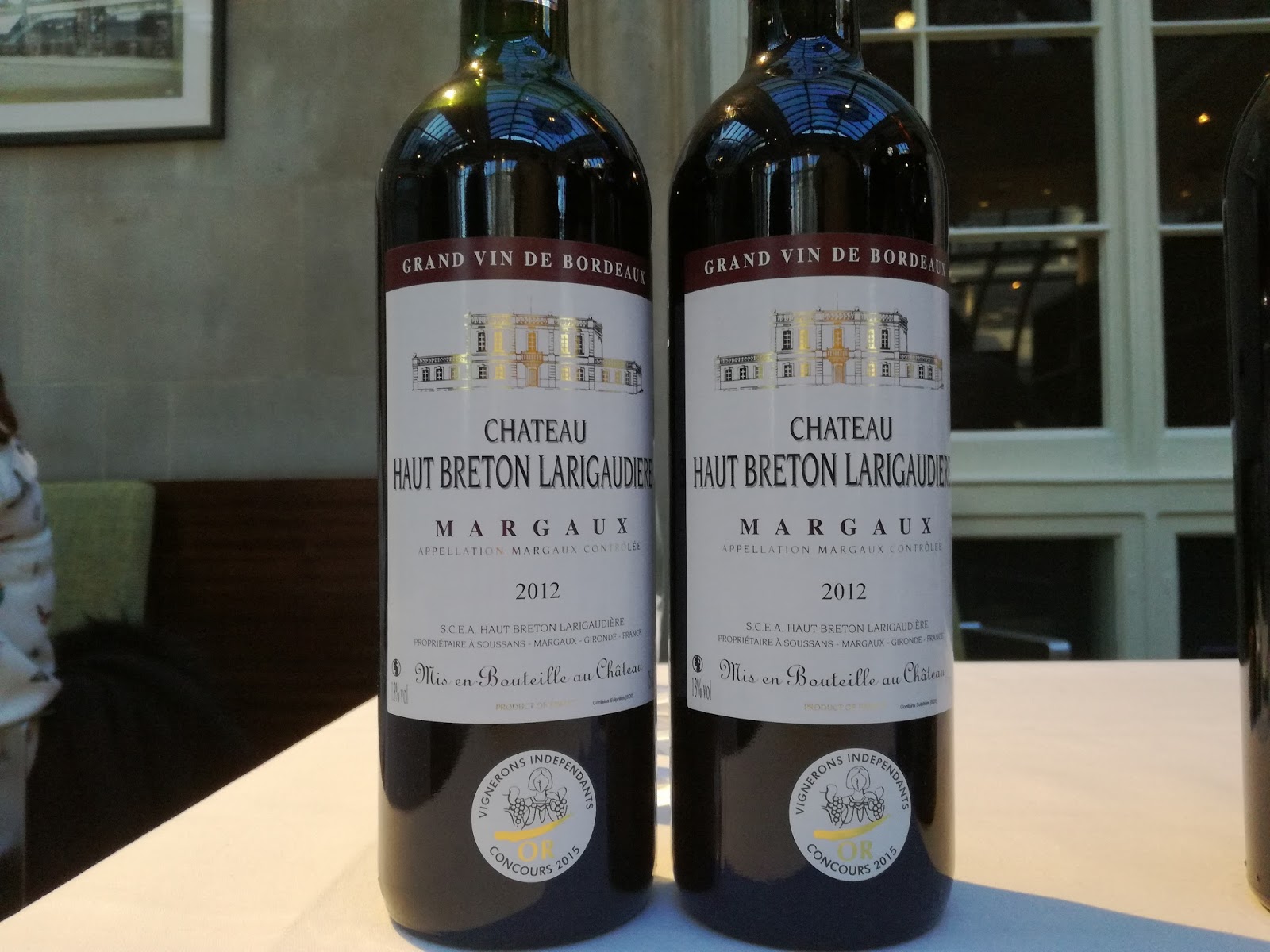
Hopping back over the river Garonne to Rive Gauche to the famous Margaux appellation, my next wine was the Chateau Haut Breton Larigaudiere, made by the De Schepper family. This 1550 hectare estate makes its own Margaux from a combination of Merlot, Cabernet Sauvignon, and Petit Verdot grapes.


The Margaux 2012 won the 2015 gold medal for Vignerons independents (independent winemakers). The estate is situated such that the grapes are grown on gravelly ridges in the Bordeaux landscape, and the “hidden ingredient” is the tiny proportion of those Petit verdot grapes. They are a very small, exceedingly difficult to cultivate grape used for its deep red, luscious colour. Unsurprisingly, the 2012 was excellent and the 2016 a work in progress to be reckoned with.


Staying on the left side of the river, I moved back to white wine to sample the Chateau de Myrat Grand Cru Classe Sauternes 2010. Don’t worry, I changed my glass! Sauternes is made in a small part of the Graves region of Bordeaux. The 2010 had a deep yellow colour with a touch of orange, with a restrained sweet aroma. The taste is everything you would expect from this utterly delightful appellation!


The current 2016 En Primeur has a makeup of Semillon grapes, 88%, Muscadelle 4% and Sauvignon 8%. Care is taken to choose the finest grapes to make the most elegant wine; the aim is to avoid strong, unsubtle sweetness in the final wine. Cultivating some minerality and a slight acidity to achieve balance is the intention. The noble rot or botrytis can occur between mid September and mid November, making planning ahead for harvesting very difficult. The 2016 needs time, but it already has the beginnings of brilliance.


Alain Raynaud is the President of the Grand Cercle des Vins de Bordeaux. A retired doctor and current wine maker, he lives and breathes the wines of Bordeaux. I had a chat to him and asked him which single wine, which single producer would be his pick. Alain recommended Haut Carles and maker Thierry Perdigon. This Rive Droite wine is a Fronsac appellation wine, made directly in the barrel.


It is rare these days for all of the fermentation to happen in the barrel, in these days of high capacity steel tanks. I asked Thierry why, and he informed me that his process enables the soft extractions of all the tannins and flavours from the grapes, which is far better than the harsher process occurring in stainless steel tanks. His bijou 7-hectare estate grows a combination of grapes with 90% Merlot, 5% Cabernet Franc and 5% Malbec making it into the smooth and highly enjoyable blend. Alain knows his wines, and this is a one a wine merchant or buyer with savvy will scoop up!


Chateau de la Dauphine was another Fronsac appellation wine which caught my attention. Each year the balance of grapes changes; the 2011 was Merlot 85%, Cabernet Franc 15%, but the 2016 En Primeur is 90% Merlot and 10% Cabernet Franc. Interestingly, the 2016 already has a deeper colour than the 2011. The 2011 wine is lightly oaked in a tasteful way, so we can expect the same from the aged 2016. I detected mild liquorice, blackberry, hints of eucalyptus and touches of minerality. 


The ground at Chateau de la Dauphine, Lisa Sauniere explained to me is very mineral, so the tannins from the grape skins temper the minerality. The 2016 has a good lingering finish for a very young wine, making it a strong candidate for a fabulous wine in 5 years’ time!


Finally, my last selection is the Entre-Deux-Mers Chateau Sainte-Marie white wine. Owner Stephane Dupuch told me that 2016 had been a great year for white wines, particularly for texture and ripening. The resulting white wine (grown over 21 hectares) is made from 71% Sauvignon Blanc, 22% Semillon, 7% Muscadelle. Stephane told me that slow ripening during 2016’s August and September has preserved the acidity of the grapes. The warm days and cool nights have been most welcome. Warm nights cause the skin to be ruined, losing aromas and flavours.


The 2016 Chateau Sainte-Marie has the crispness of Sauvignon Blanc, good richness from the Semillon. Stephane does not believe in oaking, as the goal is to bring out the grapes. I found the acidity was perfect. 2016 was a good year for both quality and quantity of grapes, a feat which only happens every 2 to three vintages in a decade. A delightful white to be enjoying soon!


Snigdha attended the En Primeurs tasting of Grand Cercle des Vins de Bordeaux as their guest. Snigdha has not received any incentive, whether paid or otherwise, for posting this review. This review represents her genuine opinions of the wines tasted.


Friday, 29 January 2016

South African Wineries; Snigdha’s selection

South African wines are capable of turning the head of the most hardened European wine buff. Producing utterly world class wine, the wines of the Rainbow Nation can give the greatest producers from anywhere in the world a run for their money. Whether you love rich reds, young light reds, mineral whites, fruity whites, method traditionelle sparkling wines, Summery roses, ripe raisiny dessert wines, there is something for your palate to find delight in here.


There are hundreds of great wineries in South Africa, so I do not pretend to have visited them all or have sampled all their wares. I have my liver to think of! But these are my picks of the wine estates I visited recently. There were others which were fun to visit or where I had great food, but do not make the cut on their wines. I hope that these are representative of the best large and small producers, but further research will be necessary. I will be going back for more one day!

If you are visiting South Africa with a view to sampling the viniculture, then Platters wine guide is a great reference for you. Updated annually, it has a helpful writeup on each winery, with reports and ratings of their best wines. A five star review in this “wine bible” is a very big deal in South Africa, and an indicator of a very special wine.

Groot Constantia, Cape Town


The Groot Constantia estate is the oldest in South Africa, dating back to 1685. Its wines have been world famous for centuries and legend has it that Napoleon’s final request was a glass of Constantia wine. Now run as a wine farm producing excellent wine but with emphasis on preserving the heritage of this estate, you get a sense of history without being trapped in a museum.

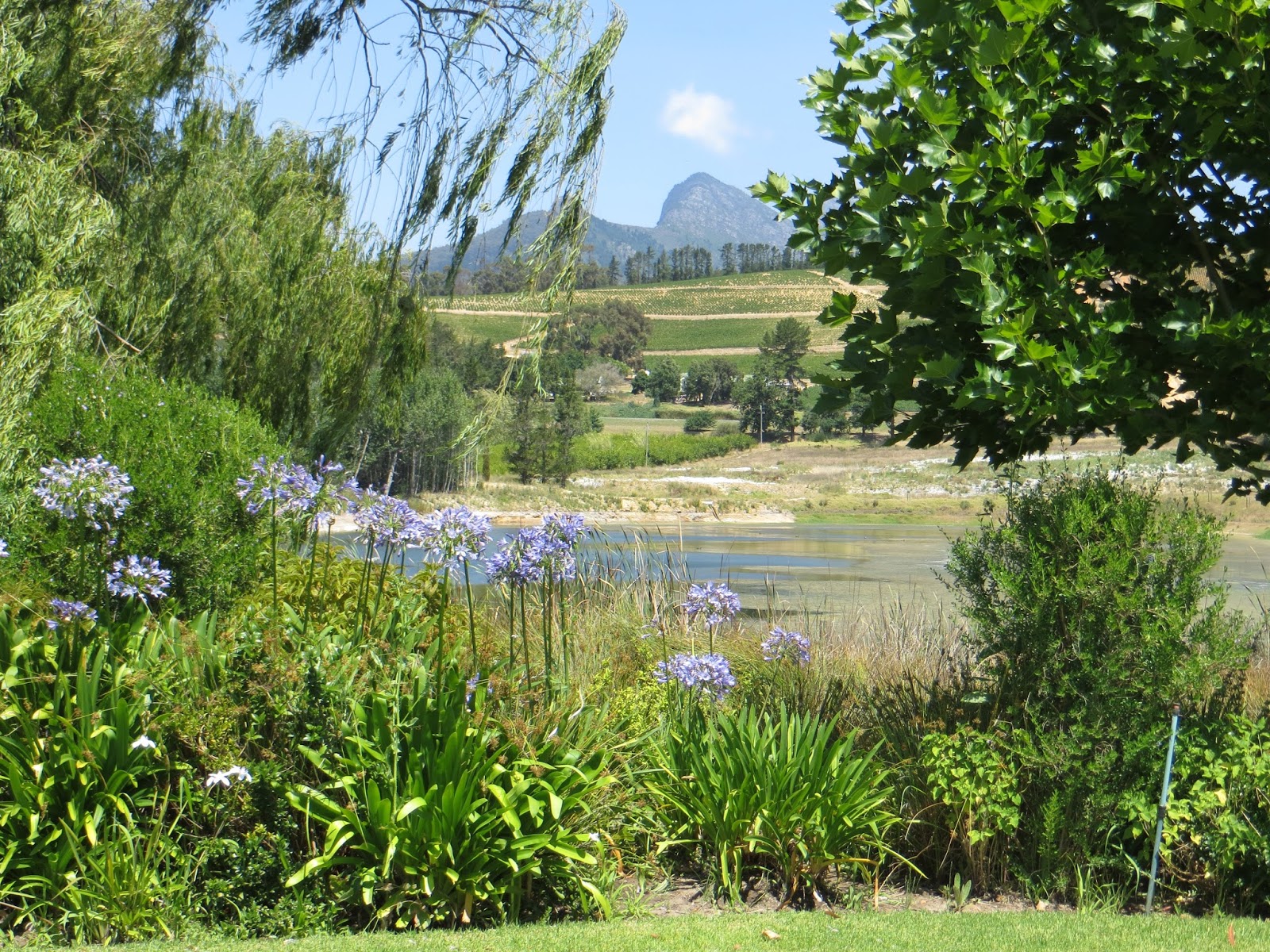
The beautiful estate is a pleasure to walk around and you can take in views of Table Mountain as well as the vines. 


Wine tastings and meals are available, but why not try something a little different? A bespoke chocolate and wine tasting is available, where the white, milk and dark chocolates and their flavourings have been developed to match with Groot Constantia’s white and red wines.


Clos Malverne, near Stellenbosch

Making wine since 1986, this winery was one of the first to make a “classic Cape blend” wine, making use of the grape varieties which are more characteristically South African.


The grapes have their juices extracted by an antiquated and labour intensive process; the basket press. This method, done completely by hand, does not denigrate the grape skins, vital for adding colour and tannins to their red wines. 


The Auret red wine is spectacular. As is the food in the superb restaurant with vineyard views. Very popular with locals, you need to book. If you want a table on the veranda looking directly over the vines and mountains, you should book early.


Warwick Estate, between Stellenbosch and Paarl

This is a family run winery, famous for its prizewinning “The First Lady” unoaked Chardonnay. Norma Ratcliffe is the “First Lady” of Warwick; the first woman to become a member of the Cape Winemakers Guild and the first to be its Chairperson.


The First Lady Unoaked Chardonnay is a revelation to those of us who convinced ourselves we didn’t like New World Chardonnay in the 1990s due to the industrial strength oaking of these wines.
Research, naturally!
I had a super picnic here at Warwick, carefully selected, locally sourced light bites, cold cuts and salad (grown in the gardens) in the sunshine looking over the lovely scenery, washed down by the wonderful “Professor Black” Sauvignon Blanc.


Aaldering, Devon Valley, Stellenbosch

Fons and Marianne Aaldering set up this wine farm in 2004 with big ambitions to be one of the best in South Africa. This very small, almost “boutique” winery is punching well above its weight, having won awards in both Europe and China. 


The red wines are the star here, with their Pinotage and their Cabernet Sauvignon-Merlot blend being some of the best I tasted. 


The peace and quiet of Devon Valley are another draw for this cute little wine estate.


You can stay in one of three traditional Cape Dutch lodge houses if you plan on spending time in the vicinity of Stellenbosch.


Bramon, Plettenberg Bay (near Knysna), The Garden Route

Most of the wineries of South Africa are in the Stellenbosch/Paarl area. However, this winery is located on the “Garden Route”; the expanse of woods and greenery you reach as you leave the Karoo, sandwiched between the hills and coast. 


“Bramon” is the conflation of the names of brother and sister owners Bram and Manon Thorpe, the winery being a real family concern. 


The proximity to the sea adds coolness and sea breeze to the superb “MCC” wines. MCC? Methodé Cap Classique, the same method used to make Champagne (being a protected region, no-one outside of the Champagne region can use the word “Champagne”, which is why you may see “method traditionelle” used elsewhere in the world).


Bramon run an eatery with great house-made tapas, inspired by local ingredients. The Bobotie cigars are a novel spin on a quintessentially South African dish.


Snigdha has not received any incentive, financial or otherwise for posting these recommendations.